Angolszász idézetek fordítással, Off Course nyelvtan videókkal és mondatgyűjteménnyel ______________________www.facebook.com/offcourseangol_____________________
The Women's March (also called the Women's March Movement, or the Women's Marches, or the Women's March on Washington and its Sister Marches or solidarity marches) was a worldwide protest on January 21, 2017, in support of women's rights and other causes including immigration reform, health care reform, protection of the natural environment, LGBTQ rights, racial justice, freedom of religion, and workers' rights. The rallies were aimed at Donald Trump, immediately following his inauguration as President of the United States, due to statements and positions of his regarded by some as misogynistic or in other ways reprehensible. It is the largest to date in a series of protests against Trump, and the largest one-day protest in U.S. history. The march drew at least half a million in Washington, and some estimates put worldwide participation at 4.8 million. At least 408 marches were planned in the U.S. and 168 in 81 other countries.
The first protest was planned in Washington, D.C., and was known as the Women's March on Washington. It was organized as a grassroots movement to "send a bold message to our new administration on their first day in office, and to the world that women's rights are human rights". The Washington March was streamed live on YouTube, Facebook, and Twitter.
After the march, officials behind the organization reported 673 marches took place worldwide, including 29 in Canada and 20 in Mexico, and at least one on all seven continents. In Washington D.C. alone, the protests were the largest political demonstrations since the anti–Vietnam War protests in the 1960s and 1970s, with both protests drawing in similar numbers. The Women's March crowds were peaceful, and no arrests were made in Washington, D.C., Chicago, Los Angeles, New York City, and Seattle, where an estimated combined total of 2 million people marched.
ugyanaz
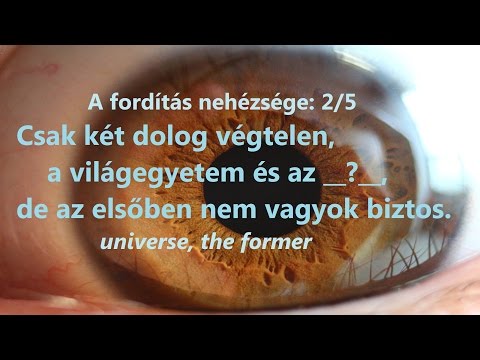
a szó illik mindenhova – rájössz-e 10 másodpercen belül, hogy
melyik? a fordításban babakönnyű a nyelvtan, a te szinteden a
szókincs is nyilván ismerős :)
http://www.theatlantic.com/
History has rendered its verdict on communism, and now Google autocomplete has too.
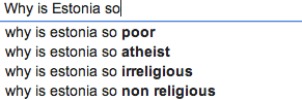
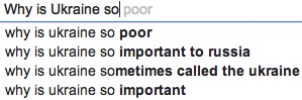
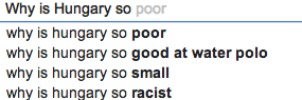
That verdict? Well, see for yourself. Try searching "Why is Estonia so...." Now try "Why is Ukraine so...." And "Why is Hungary so...." Notice a pattern?
As you can see in the map above from Randal Olson, most people want Google to tell them why post-communist Europe is still so poor. Though there are some exceptions. The top result for Poland is "weak." For Lithuania, it's "suicidal." Russia, Slovenia, Macedonia, Croatia, and the Czech Republic all at least get off with more neutral ones. (And Turkey's is most certainly for the meat, not the country)...
2016. második legnépszerűbbje: a blogon találsz még több mint 150 jófajta angol idézetet
fordítással, nyelvtan-videókkal, a nyelvtan használatát bemutató kétnyelvű mondattárral,
szókártyákkal. sőt, ha követed az Off Course Angol oldal fészbuk-oldalát,
akkor hetente újabb idézetekhez jutsz!
Off Course Angol tanár nélkül -- ahogy még nem csináltad :)
2016. legnépszerűbbje: igeidők -- a blogon pedig még több mint 150 jófajta angol idézet fordítással, nyelvtan-videókkal, a nyelvtanhoz kétnyelvű mondattárral, szókártyákkal. sőt, hetente újabb idézetekhez jutsz, ha követed az Off Course Angol oldal fészbuk-oldalát!
Off Course Angol tanár nélkül -- ahogy még nem csináltad :)
rájössz-e,
mivel riposztolt John politikus Henry politikusnak?... a fordításhoz
minden dőlt betűst használj fel – akkor akár az eredetit is elő
tudod állítani :)
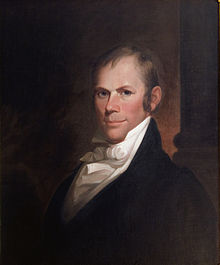
Wikipedia: Henry Clay, Sr. (April 12, 1777 – June 29, 1852) was an American lawyer and planter, statesman, and skilled orator who represented Kentucky in both the United States Senate and House of Representatives. He served three non-consecutive terms as Speaker of the House of Representatives and served as Secretary of State under President John Quincy Adams from 1825 to 1829. Clay ran for the presidency in 1824, 1832 and 1844, while also seeking his party's nomination in 1840 and 1848. However, he was unsuccessful in all of his attempts to reach his nation's highest office. Despite his presidential losses, Clay remained a dominant figure in the Whig Party, which he helped found in the 1830s...
During the fourteen years following his first election, Clay was re-elected five times to the House and to the speakership. Clay's re-election as Speaker was aided by the weakness of the Federalist Party, which failed to win control of either chamber of Congress after 1801. Clay's tenure in the House was interrupted from 1814 to 1815, when he traveled to Europe to negotiate a peace treaty with the British, and from 1821 to 1823, when Clay briefly retired to rebuild his family's fortune in the aftermath of the Panic of 1819. With a tenure of ten years and 196 days, Clay served more than twice as long as any other pre-Civil War Speaker. Only Sam Rayburn has occupied the office for a longer amount of time...
Portrait by Matthew Harris Jouett, 1818
As Secretary of State, Clay lived with his family and slaves in Decatur House on Lafayette Square. As he was preparing to return to Lexington in 1829, his slave Charlotte Dupuy sued Clay for her freedom and that of her two children, based on a promise by an earlier owner. Her legal challenge to slavery preceded the more famous Dred Scott case by 27 years. The "freedom suit" received a fair amount of attention in the press at the time. Dupuy's attorney gained an order from the court for her to remain in DC until the case was settled, and she worked for wages for 18 months for Martin Van Buren, Clay's successor as Secretary of State and the Decatur House. Clay returned to Ashland with Aaron, Charles and Mary Ann Dupuy.
The jury ruled against Dupuy, deciding that any agreement with her previous master Condon did not bear on Clay. Because Dupuy refused to return voluntarily to Kentucky, Clay had his agent arrest her. She was imprisoned in Alexandria, Virginia, before Clay arranged for her transport to New Orleans, where he placed her with his daughter and son-in-law Martin Duralde. Mary Ann Dupuy was sent to join her mother, and they worked as domestic slaves for the Duraldes for another decade.
In 1840 Henry Clay finally gave Charlotte and her daughter Mary Ann Dupuy their freedom. He kept her son Charles Dupuy as a personal servant, frequently citing him as an example of how well he treated his slaves. Clay granted Charles Dupuy his freedom in 1844. While no deed of emancipation has been found for Aaron Dupuy, in 1860 he and Charlotte were living together as free black residents in Fayette County, Kentucky. He may have been freed or "given his time" by one of Clay's sons, as Dupuy continued to work at Ashland, for pay.
ha
voltál már szerelmes, rögtön rájössz, mi hiányzik – ha épp
most kaptad el, egészen biztosan nem találod ki... mielőtt
lefordítod, nézz rá a nyelvtani segítségre és a dőlt
betűsökre, hátha akkor sikerül :)
Wikipedia: ...Greek distinguishes several different senses in which the word "love" is used. Ancient Greeks identified four forms of love: kinship or familiarity (in Greek, storge), friendship and/or platonic desire (philia), sexual and/or romantic desire (eros), and self-emptying or divine love (agape)...
...The Latin language has several different verbs corresponding to the English word "love." amō is the basic verb meaning I love, with the infinitive amare (“to love”) as it still is in Italian today. The Romans used it both in an affectionate sense as well as in a romantic or sexual sense. From this verb come amans — a lover, amator, "professional lover," often with the accessory notion of lechery — and amica, "girlfriend" in the English sense, often being applied euphemistically to a prostitute. The corresponding noun is amor (the significance of this term for the Romans is well illustrated in the fact, that the name of the City, Rome — in Latin: Roma—can be viewed as an anagram for amor, which was used as the secret name of the City in wide circles in ancient times), which is also used in the plural form to indicate love affairs or sexual adventures. This same root also produces amicus — "friend" — and amicitia, "friendship" (often based to mutual advantage, and corresponding sometimes more closely to "indebtedness" or "influence"). Cicero wrote a treatise called On Friendship (de Amicitia), which discusses the notion at some length. Ovid wrote a guide to dating called Ars Amatoria (The Art of Love), which addresses, in depth, everything from extramarital affairs to overprotective parents...
...In contemporary Chinese, Ai (愛) is often used as the equivalent of the Western concept of love. Ai is used as both a verb (e.g. wo ai ni 我愛你, or "I love you") and a noun (such as aiqing 愛情, or "romantic love"). However, due to the influence of Confucian Ren, the phrase 'Wo ai ni' (I love you) carries with it a very specific sense of responsibility, commitment and loyalty. Instead of frequently saying "I love you" as in some Western societies, the Chinese are more likely to express feelings of affection in a more casual way. Consequently, "I like you" (Wo xihuan ni, 我喜欢你) is a more common way of expressing affection in Chinese; it is more playful and less serious. This is also true in Japanese (suki da, 好きだ). The Chinese are also more likely to say "I love you" in English or other foreign languages than they would in their mother tongue...
...The Japanese language uses three words to convey the English equivalent of "love". Because "love" covers a wide range of emotions and behavioral phenomena, there are nuances distinguishing the three terms. The term ai (愛), which is often associated with maternal love or selfless love, originally referred to beauty and was often used in religious context. Following the Meiji Restoration 1868, the term became associated with "love" in order to translate Western literature. Prior to Western influence, the term koi (恋) generally represented romantic love, and was often the subject of the popular Man'yōshū Japanese poetry collection. Koi describes a longing for a member of the opposite sex and is typical interpreted as selfish and wanting. The term's origins come from the concept of lonely solitude as a result of separation from a loved one. Though modern usage of koi focuses on sexual love and infatuation, the Manyō used the term to cover a wider range of situations, including tenderness, benevolence, and material desire. The third term, ren'ai (恋愛), is a more modern construction that combines the kanji characters for both ai and koi, though its usage more closely resembles that of koi in the form of romantic love...
felnőttes tartalom... vajon kitalálod-e, mi hiányzik? – ha ránézel a dőlt betűsökre és a nyelvtani segítségre, a fordításban még mindig lehet 2 (nyelvi) hibád :(
Wikipedia: The Kama Sutra (Sanskrit: कामसूत्र, Kāmasūtra) is an ancient Indian Hindu text written by Vātsyāyana. It is widely considered to be the standard work on human sexual behaviour in Sanskrit literature.
A portion of the work consists of practical advice on sexual intercourse. It is largely in prose, with many inserted anustubh poetry verses. "Kāma" which is one of the four goals of Hindu life, means desire including sexual desire the latter being the subject of the textbook, and "sūtra" literally means a thread or line that holds things together, and more metaphorically refers to an aphorism (or line, rule, formula), or a collection of such aphorisms in the form of a manual.
Contrary to western popular perception, the Kama Sutra is not exclusively a sex manual; it presents itself as a guide to a virtuous and gracious living that discusses the nature of love, family life and other aspects pertaining to pleasure oriented faculties of human life. Kama Sutra, in parts of the world, is presumed or depicted as a synonym for creative sexual positions; in reality, only 20% of Kama Sutra is about sexual positions. The majority of the book, notes Jacob Levy, is about the philosophy and theory of love, what triggers desire, what sustains it, how and when it is good or bad.
The Kama Sutra is the oldest and most notable of a group of texts known generically as Kama Shastra (Sanskrit: Kāma Śāstra).
Historians attribute Kamasutra to be composed between 400 BCE and 200 CE. John Keay says that the Kama Sutra is a compendium that was collected into its present form in the 2nd century CE...
...The most widely known English translation of the Kama Sutra was privately printed in 1883. It is usually attributed to renowned orientalist and author Sir Richard Francis Burton, but the chief work was done by the Indian archaeologist Bhagwan Lal Indraji, under the guidance of Burton's friend, the Indian civil servant Forster Fitzgerald Arbuthnot, and with the assistance of a student, Shivaram Parshuram Bhide. Burton acted as publisher, while also furnishing the edition with footnotes whose tone ranges from the jocular to the scholarly...
...An English translation by Wendy Doniger and Sudhir Kakar, an Indian psychoanalyst and senior fellow at Center for Study of World Religions at Harvard University, was published by Oxford University Press in 2002. Doniger contributed the Sanskrit expertise while Kakar provided a psychoanalytic interpretation of the text...
Wikipedia: A Tanár úr kérem Karinthy Frigyes (1887–1938) karcolatfüzére, melyet 1916-ban adtak ki először Vértes Marcell rajzaival, Dick Manó könyvkiadó vállalkozó jóvoltából. A mű egyfajta „emlékezés” a gyermekkorra, Karinthy diákéveire.
Több feldolgozás is megjelent az évek során. 1956-ban filmet készített belőle Mamcserov Frigyes. A filmvásznon feltűnt többek között Makláry Zoltán és Gobbi Hilda is.
Az 1990-es években megjelent egy hangkazetta Tanár úr kérem címmel, Garas Dezső előadásában. CD formájában is napvilágot látott a mű, Karinthy és más írások címmel. Ez esetben Rudolf Péter tolmácsolja Karinthy regényét.
Az első kiadás könyvborítója (illusztrálta: Vértes Marcell)
...A Reggel hétkor című fejezetben Bauer nagyon nehezen ébred reggel. Még félálomban a következő gondolatok suhannak át az agyán: Mákossy tanár úrnál felel földrajzból. A tanár Dániát kérdezi tőle, de nem tudja rá a választ. Majd azt, hogy ő egy híres hadvezér, akinek el kell foglalnia Dániát. Most ő felelteti a tanár urat, aki nem tudja megmondani Dánia fővárosát, pedig az Budapest, mert hozzácsatolták Magyarországhoz. Álmából Erzsi, a szobalány riasztja fel azzal, hogy nyolc óra és elkésett az iskolából...
...Az Elkéstem című részben Bauer reggel késésben rohan az iskolába, és útközben próbálja végiggondolni, hogy mi várható aznap. Az első óra mennyiségtan, ahol Frőhlich tanár úr valószínűleg feleltetni fog. Hősünk a mennyiségtan dolgozatot nem készítette el. Elég rosszak tehát a kilátások. Sietve rohan be az iskolába, ahol már becsengettek. Lesütött fejjel ül be a padba, és ami még szörnyűbb, felelés következik…
...A jó tanuló felel leírja, hogy milyen egy jó felelet. A tanár hosszas naplólapozgatás után Steinmannt, az osztály legjobb tanulóját hívja ki felelni. Egy érdekes matematikai feladatot kell megoldania egy csonkagúlával kapcsolatban. A jó tanuló mindent tud, és felelete rövid, meggyőző...
...A rossz tanuló felel egy tipikus rossz feleletet mutat be. A rossz tanuló útközben ismételgeti magában az aznapi leckét. Egy másodfokú egyenletet kell megoldania, de nem boldogul vele. Lassan ír a táblára, hogy ezzel is időt nyerjen, de semmi sem segít. Végül a tanár kihív egy újabb tanulót felelni. A rossz tanuló megszégyenülten áll, végül a kudarc után a helyére kullog, és eldönti, hogy gimnázium helyett inkább katonai pályára lép...
...A Röhög az egész osztály címe magáért beszél, nevetéssel van tele az egész fejezet. A tanulók nem rendeltetésszerűen használják a szemetesládát, Roboz és Kelemen cédulákat ragasztgatnak egymás hátára, nem tudván, hogy az ő hátukon is lóg egy. Auert egyikük felcipeli a harmadik emeletre, hogy valamilyen fontos ügyben keresik. A szegény fiú a fellegekben jár, és kell egy kis idő, hogy rájöjjön, átverés áldozata lett. Wlach pimasz karikatúrát rajzol Kökörcsin tanár úrról és II. Józsefről. Zajcsek tanulni szeretne, de az ordibálástól nem tud, ezért elbújik a szemetesládában. A többiek erre úgy tesznek, mintha bejött volna a tanár. A csendre Zajcsek előmászik, erre az osztálytársai kinevetik. Amikor valóban bejön a tanár, és elül a zaj, Zajcsek már nem hagyja becsapni magát, bennemarad a ládában. A feszült csendben Kökörcsin tanár úr a kedvenc témáját fejtegeti. Szerepel, nem tanít. Nem is figyel igazán a gyerekekre, így azok sem őrá, hiszen Zajcsek miatt - aki még mindig a kukában csücsül -, már majdnem kibuggyan belőlük a nevetés. A kis Löbl a pad alatt mászkál, Eglmayer gyomorhangon közbeszól, Auer felszisszen. Ekkor megszólal a tanár: - Auer... mit mozgolódik maga, mint egy sajtkukac? Erre a mondatra végre mindenkiből kitörhet a korábban elfojtott nevetés. A tanár pedig csodálkozva néz körül, majd büszkén megállapítja, hogy milyen „frappáns és ellenállhatatlan humora van neki”...
ha házas vagy, házasodni vagy válni készülsz, simán kitalálhatod, mi hiányzik :) a fordítás pedig a dőlt betűs
szókincs-segítséggel már pihekönnyű, bár szinte
biztos, hogy egy hibát el fogsz követni :(
Wikipedia: Zsa Zsa Gabor (/ˈʒɑːʒɑː ˈɡɑːbɔːr, ɡəˈbɔːr/ zhah-zhah gah-bor, gə-bor; Hungarian: [ˈʒɒʒɒ ˈɡaːbor]; born Sári Gábor [ˈʃaːri ˈɡaːbor]; February 6, 1917 – December 18, 2016) was a Hungarian-American actress and socialite. Her sisters were actresses Eva and Magda Gabor.
Gabor began her stage career in Vienna and was crowned Miss Hungary in 1936. She emigrated from Hungary to the United States in 1941. Becoming a sought-after actress with "European flair and style", she was considered to have a personality that "exuded charm and grace". Her first film role was a supporting role in Lovely to Look At. She later acted in We're Not Married! and played one of her few leading roles in the John Huston-directed film, Moulin Rouge (1952). Huston would later describe her as a "creditable" actress.
Outside her acting career, Gabor was known for her extravagant Hollywood lifestyle, her glamorous personality, and her many marriages. In total, Gabor had nine husbands, including hotel magnate Conrad Hilton and actor George Sanders. She once stated, "Men have always liked me and I have always liked men. But I like a mannish man, a man who knows how to talk to and treat a woman — not just a man with muscles."...
Zsazsa 1958-ban
...On November 28, 2002, Gabor was a front seat passenger in an automobile crash in Sunset Boulevard, Los Angeles, from which she remained partially paralyzed and reliant on a wheelchair for mobility. She survived strokes in 2005 and 2007 and underwent surgeries. In 2010, she fractured her hip and underwent a successful hip replacement.
In August 2010, Gabor was admitted to Ronald Reagan UCLA Medical Center in serious condition and received last rites from a Catholic priest.
In 2011, her right leg was amputated above the knee to save her life from an infection. She was hospitalized again in 2011 for a number of emergencies.
On February 8, 2016, two days after her 99th birthday, Gabor was rushed to hospital after suffering from breathing difficulties. She was diagnosed with a feeding tube-related lung infection and was scheduled to undergo surgery to have her feeding tube removed.
In April 2016, Gabor expressed her wish to move back to Hungary in 2017 and live out the rest of her life there. Her husband stated that he was determined to make her wish come true and he intended to arrange for "a big party in the summer" to celebrate the actress' 100th birthday, after which she would return to Budapest....
...Gabor died at the age of 99 of cardiac arrest at Ronald Reagan UCLA Medical Center,[1] on December 18, 2016, less than two months before she would have become a centenarian. She had been on life support for the previous five years. She is survived by husband Frédéric Prinz von Anhalt, whom she wed in 1986.
bölcs
vagy, ha tudod ezt a tutit is... a fordításhoz is nyilván elég jó
vagy – az eredeti változatot csak úgy találhatod el, hogy
felhasználod a dőlt betűsöket, de úgy tényleg sikerülhet :)
...Have you ever created a list of the first 50 or so most memorable life experiences that pop into your head when you think back over your years?... For a long time now, I’ve been a firm believer that the goal of life, regardless of what path you choose, is simply to be able to smile when it all comes to an end, when we are forced to reflect upon everything we’ve done...
...If you were to make a list of the 50 or so experiences that pop into your mind when you stop to reflect about where your life has taken you… …what does that list look like and how do you feel when you finish reading it?...
Taking a shower in a small wooden closet down a tiny alley in Kabul every morning during my stay. It was a local hamam where most of the residents in the area bathed each day...
...Trying to sleep under the stars in the middle of the desert near Alice Springs, Australia, telling myself I would close my eyes after seeing just one more shooting star…and repeating this over and over again until I spent almost the entire night staring at the star-filled sky.
Eating the largest schnitzel I’ve ever seen with two good friends...
...Being kidnapped in Dhaka, Bangladesh by the most inexperienced and useless kidnappers on the planet (thankfully)...
...Walking around Mostar for a day with several other travelers, randomly ending up in a well-known crepe shop where we ate a lot of yummy crepes while having a superb time interacting with the locals around us for a couple of hours.
New Year’s at a house party in Sofia.
Stumbling upon the fantastic Museum of Broken Relationships in Zagreb...
...The Egyptian Antiquities Museum in Cairo. I could have spent several days in there...
Staying at the Bengkstar Lighthouse, located in the Archipelago Sea some 25 kms from the coast of Finland, for a night where I enjoyed the complete isolation (I was the only guest), spent time in the sauna, ate delicious home-cooked meals and hung out with the two staff working there. This is one night I will never forget.
Going sledding in Annecy, France over New Year’s and actually having an absolute blast as I tumbled and crashed for several hours despite my extreme dislike for cold, snow and any activity that involves either cold weather or snow...
...Going on a road trip from Budapest to Lake Balataon to Split to Dubrovnik to Cavtat with a local Hungarian friend in a tiny 1970s Fiat.
Standing in the town of Isafjordur in the northwest corner of Iceland, wondering how on earth I got there, talking with some local teenagers and finding the completely quiet and calm atmosphere to be quite eerie, yet quite appealing at the same time...
...Smoking some local stuff with a fellow traveler, peeing my pants and then walking across an island in the middle of the Mekong River in southern Laos in order to catch a glimpse of the Irrawaddy Dolphins...
...Meeting up with a family in Skopje, Macedonia that was friends with a friend of mine and having them take me into their home for several days, invite me to a huge family gathering/party and so graciously show me all over their city...
...Sitting in a cafe in Chisinau, Moldova only to have several people ask me why I was in Moldova and then invite me to hang out during the day and at night, giving me a better insight into the country than I could have ever imagined...
...Meeting so many wonderful people in Ljubljana that I quickly reached the conclusion that this was one city I could live in for a long time.
...Staying with a local family in the mountains of southern Ukraine...
...This has been my life. And when I read that list, I do feel happy. I smile widely and I feel satisfied with where my life has taken me.
I’m not saying that I’m 100% ecstatic about everything of course. I’ve done plenty of dumb things, made plenty of terrible decisions, have had plenty of issues, peed my pants more than that one time in Laos and missed out on a long list of experiences that people who have taken a different path have been fortunate to enjoy. That’s life, as they say, no matter what route you choose.
I wrote the above list because I genuinely wanted to see if the experiences I’ve been through have been sufficiently fulfilling, if the decisions I’ve made over the years have been worth it overall.
Travel itself does not equal automatic happiness. It’s what those experiences mean to each of us, how they match with what we hoped to gain from life.
There are plenty of really unhappy travelers out there in the world and there are also plenty of incredibly happy people who have never left home!
na
vajon melyik szó hiányozhat egy falfirkás humorból?... a fordítása szókincs-segítséggel nem nehezebb 2/5 szintnél – legalábbis ha
már megnézted az igeidők videót, ugye :)
Wikipedia:
In the Gregorian calendar, New Year's Eve (also known as Old Year's
Day or Saint Sylvester's Day in many countries), the last day of the
year, is on December 31 which is six days after Christmas.
Samoa
and parts of Kiribati are the first places to welcome the New Year
while American Samoa and Baker Island in the United States, are among
the last...
New
Year's Eve (Szilveszter) in Hungary is celebrated with home parties
and street parties, including a gathering in downtown Budapest.
Fireworks and firecrackers are popular. Champagne, wine and
traditional Hungarian New Year dishes — frankfurter sausages with
horseradish, lentil soup, fish, and roast pig — are consumed. The
national anthem is commonly sung at midnight.
In
Budapest, the Timewheel runs out on New Year's Eve, and is
mechanically rotated so that the sand run through it for another
year.
In
past centuries, some Hungarians believed that animals were able to
speak on New Year's Eve, and that onion skins sprinkled with salt
could indicate a rainy month.
Hungarian
Christian communities focus on celebrating Mass on both New Year's
Eve and New Year's Day...
In
English-speaking countries, a few popular songs are associated with
New Year's Eve, and it is common for them to be broadcast via radio
on (or shortly before) December 31: Even some Christmas songs focus on
the arrival of a new year during the Christmas and holiday season.
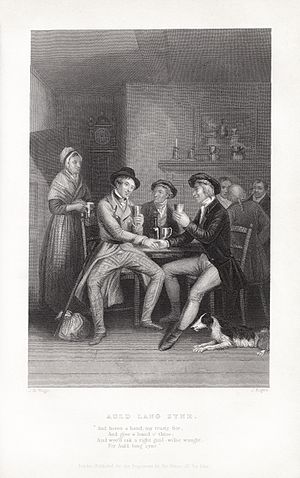
"Auld
Lang Syne" by Robert Burns. This is the song most closely
associated with the holiday – especially the Guy Lombardo musical
rendition. A version performed by Lea Michele was featured in the
2011 film New Year's Eve.
John
Masey Wright and John Rogers' c. 1841 illustration of Auld Lang Syne.
"Happy
New Year" by ABBA.
"Imagine"
by John Lennon.
"It
Was a Very Good Year" by Frank Sinatra.
"It's
Just Another New Year's Eve" by Barry Manilow.
"Let's
Start the New Year Right" by Bing Crosby.
"New
Year's Day" by U2.
"Same
Old Lang Syne" by Dan Fogelberg.
"Let's
Spend This New Year's Eve At Home" by Christi Bauerlee.
"Kiss
Me at Midnight" by 'N Sync from their 1998 album The Winter
Album.
One of the main reasons we have the custom of giving and receiving presents at Christmas, is to remind us of the presents given to Jesus by the Wise Men: Frankincense, Gold and Myrrh...
-- Frankincense was a perfume used in Jewish worship and, as a gift, it showed that people would worship Jesus.
-- Gold was associated with Kings and Christians believe that Jesus is the King of Kings.
-- Myrrh was a perfume that was put on dead bodies to make them smell nice and, as a gift, it showed that Jesus would suffer and die.
Christmas itself is really about a big present that God gave the world about 2000 years ago - Jesus! One of the most famous Bible verses, John 3:16, says: 'God loved the world so much, that he gave his one and only Son, so that whoever believes in him may not be lost but have eternal life.'.
All over the world, families and friends give presents to each other. Most children around the world believe in a Christmas gift bringer. It's often St. Nicholas, Santa Claus or Father Christmas, but in Germany they believe that it is the Christkind, in Spain they believe it is the Wise Men and in Italy they believe it is an old lady called Befana.
These presents are also left in different places! In most of Europe, the presents are left in shoes or boots put out by the children. In Italy, the UK and the USA presents are left in stockings, often left hanging by a fire place. In many countries, presents for friends and family may be left under the Christmas Tree. In the UK, they are often opened on Christmas day morning with all the family together.
The custom of hanging stockings comes from the story of St. Nicholas.
Presents are opened on different days over the world as well. The earliest presents are opened is on St. Nicholas' Eve on December 5th when children in Holland of ten receive their presents. On St. Nicholas' Day (6th December) children in Belgium, Germany, Czech Republic and some other European countries open some of their presents.
Children in the UK, USA and many other countries, such as Japan, open their presents on Christmas Day, December 25th. The latest presents are opened on January 6th (a month after the earliest). This is known as Epiphany and is mainly celebrated in Catholic countries such Spain and Mexico.
One popular way of giving presents in groups such as clubs, school classes and workplaces is to have a 'Secret Santa'. This is where you pull the name of someone else in the group out of a hat (or other container!). You then buy a present for that person. When the presents are given out (often at a Christmas party) each person is given their present but they have no idea which person in the group bought it for them!
Wikipedia: Leslie "Les" Dawson, Jr. (2 February 1931 – 10 June 1993) was an English comedian, actor, writer, and presenter, who is best remembered for deadpan style, curmudgeonly persona and jokes about his mother-in-law and wife.
Dawson claimed in his entertaining but unreliable autobiography that he began entertaining as a pianist in a Parisian brothel ... He was a talented pianist but developed a gag in which he played a familiar piece such as Beethoven's Moonlight Sonata and then introduced hideously wrong notes (yet not destroying the tune) without appearing to realise, smiling unctuously and relishing the accuracy and soul of his own performance. ... Dawson's style as a comic was world-weary, lugubrious and earthy. He was as popular with female as with male audiences. A reporter from The Sun found him backstage joking with cleaning women and making them laugh. ... Before his fame Dawson wrote poetry and kept it secret. It was not expected that someone of his working class background would have literary ambitions. ... Having broken his jaw in a boxing match, he could pull grotesque faces by pulling his jaw over his upper lip. ... Dawson was a heavy smoker and drinker. When not working he would often drink a bottle of whisky and smoke 50 cigarettes a day.
így érez az ember Off Course –
ha már tudod, hogyan, fordítsd le, ha vállalod, hogy felhasználod
a dőlt betűs segítséget, akkor azért inkább 3/5 szintű a
feladat. ügyes légy :)
I am living-the-dream as a painter, instructor, juror, and lecturer.
I live to be creative. I am inspired by things I see around me - a line, a shadow, a texture, a color. Form and shape and how color masses interact - it's all part of what gets me going in a creative pursuit.
My style goes from realism to abstraction. I love doing both, but my workshops and private instruction tend to focus on my mixed media work, which definitely leans to abstraction. The artist's creative energy needs to be focused to be successful at abstract work, and that's why I love it.
As a Golden Art Educator, teaching others, and sharing my knowledge, has become a big part of my art career. Since I love to experiment with different materials, other artists come to me to learn some of the techniques I've developed for my abstract work. I love sharing what I've learned with other artists through classes and workshops around the country. In addition to workshops, I also offer private and semiprivate instruction in my studio near Denver, Colorado.
My work is collected by individuals, corporations and civic entities. They find me by word of mouth, art shows, galleries, exhibitions, and through the internet. I've been recognized with many competitive awards by national art magazines and organizations. I am a member of the International Society of Experimental Artists (ISEA), several Colorado art guilds, and a signature member of the International Society of Acrylic Painters (ISAP).
So welcome to my website. Everything is divided into categories according to painting style and/or subject matter. The "small paintings " is a very diverse collection and defined only by size. You'll find abstracts, flowers, horses, teapots - you name it. They are priced for someone starting their collection or someone looking to add a splash of color in a certain spot in their home.
Be sure to sign up for my free e-newsletter. I'll never share your email address with anyone, and I won't bombard your inbox with trivia. I just send out 4-6 newsletters a year when I have something new, or possibly earth shattering, to tell you about. Thanks for visiting. Feel free to bookmark this site and forward it to friends.
Tavaly óta semmi nem változott... Global
Warming and Merry Christmas, Off Course :) –ha
már kitaláltad, melyik szó hiányzik (érezz bele, fog menni), fordítsd is le (használj fel minden magánhangzót)!
Wikipedia: Christmas or Christmas Day (Old English: Crīstesmæsse, meaning "Christ's Mass") is an annual festival commemorating the birth of Jesus Christ, observed most commonly on December 25 as a religious and cultural celebration among billions of people around the world...
..."Christmas" is a shortened form of "Christ's mass". It is derived from the Middle English Cristemasse, which is from Old English Crīstesmæsse, a phrase first recorded in 1038 followed by the word Cristes-messe in 1131. Crīst (genitive Crīstes) is from Greek Khrīstos (Χριστός), a translation of Hebrew Māšîaḥ (מָשִׁיחַ), "Messiah", meaning "anointed"; and mæsse is from Latin missa, the celebration of the Eucharist. The form Christenmas was also historically used, but is now considered archaic and dialectal; it derives from Middle English Cristenmasse, literally "Christian mass". Xmas is an abbreviation of Christmas found particularly in print, based on the initial letter chi (Χ) in Greek Khrīstos (Χριστός), "Christ", though numerous style guides discourage its use; it has precedent in Middle English Χρ̄es masse (where "Χρ̄" is an abbreviation for Χριστός)...
Map of countries where Christmas is not a formal public holiday
either on December 24/25 or January 6/7.
...Allegations of political correctness
Some Christians and organizations such as Pat Robertson's American Center for Law and Justice cite alleged attacks on Christmas (dubbing them a "war on Christmas"). Such groups claim that any specific mention of the term "Christmas" or its religious aspects is being increasingly censored, avoided, or discouraged by a number of advertisers, retailers, government (prominently schools), and other public and private organizations. One controversy is the occurrence of Christmas trees being renamed Holiday trees. In the U.S. there has been a tendency to replace the greeting Merry Christmas with Happy Holidays, which is considered inclusive at the time of the Jewish celebration of Hanukkah. In the U.S. and Canada, where the use of the term "Holidays" is most prevalent, opponents have denounced its usage and avoidance of using the term "Christmas" as being politically correct. Groups such as the American Civil Liberties Union have initiated court cases to bar the display of images and other material referring to Christmas from public property, including schools. Such groups argue that government-funded displays of Christmas imagery and traditions violate the First Amendment to the United States Constitution, which prohibits the establishment by Congress of a national religion. In 1984, the U.S. Supreme Court ruled in Lynch v. Donnelly that a Christmas display (which included a Nativity scene) owned and displayed by the city of Pawtucket, Rhode Island, did not violate the First Amendment. In November 2009, the federal appeals court in Philadelphia upheld a school district's ban on the singing of Christmas carols. The US Supreme Court declined to hear an appeal...
Wikipedia: Many types of payments or favors can constitute bribes: tip, gift, sop, perk, skim, favor, discount, waived fee/ticket, free food, free ad, free trip, free tickets, sweetheart deal, kickback/payback, funding, inflated sale of an object or property, lucrative contract, donation, campaign contribution, fundraiser, sponsorship/backing, higher paying job, stock options, secret commission, or promotion (rise of position/rank).
One must be careful of differing social and cultural norms when examining bribery. Expectations of when a monetary transaction is appropriate can differ from place to place. Political campaign contributions in the form of cash, for example, are considered criminal acts of bribery in some countries, while in the United States, provided they adhere to election law, are legal. Tipping, for example, is considered bribery in some societies, while in others the two concepts may not be interchangeable.
In some Spanish-speaking countries, bribes are referred to as "mordida" (literally, "bite"). In Arab countries, bribes may be called baksheesh (a tip, gift, or gratuity) or "shay" (literally, "tea"). French-speaking countries often use the expressions "dessous-de-table" ("under-the-table" commissions), "pot-de-vin" (literally, "wine-pot"), or "commission occulte" ("secret commission" or "kickback"). While the last two expressions contain inherently a negative connotation, the expression "dessous-de-table" can be often understood as a commonly accepted business practice (for instance, on the occasion of a real estate transaction before the notary, a partial payment made between the buyer and seller; needless to say, this is a good way to launder money). In German, the common term is Schmiergeld ("smoothing money")...
...Referees and scoring judges may be offered money, gifts, or other compensation to guarantee a specific outcome in an athletic or other sports competition. A well-known example of this manner of bribery in sport would be the 2002 Olympic Winter Games figure skating scandal, where the French judge in the pairs competition voted for the Russian skaters in order to secure an advantage for the French skaters in the ice dancing competition...
...Bribery around the world is estimated at about $1 trillion (£494bn)...
A world map of the 2015 Corruption Perceptions Index by Transparency International which measures "the degree to which corruption is perceived to exist among public officials and politicians". High numbers (blue) indicate less perception of corruption, whereas lower numbers (red) indicate higher perception of corruption.
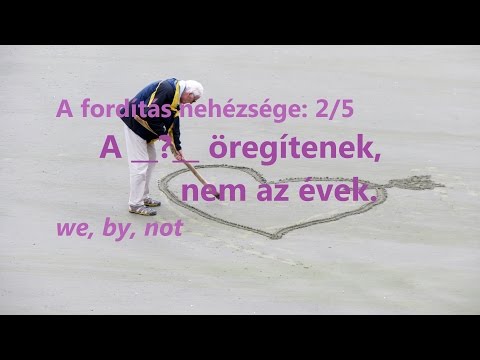
(from “War” by Joshua J. Mark published on 02 September 2009)
The word 'war' comes to English by the old High German language word 'Werran' (to confuse or to cause confusion) through the Old English 'Werre' (meaning the same), and is a state of open and usually declared armed conflict between political entities such as sovereign states or between rival political or social factions within the same state. The Prussian military analyst Carl Von Clausewitz, in his book On War, calls it, “continuation of politics carried on by other means.” War is waged by political entities, nations or, earlier, city states in order to resolve political or territorial disputes and are carried out on the battlefield by armies comprised of soldiers of the contending nations or by mercenaries paid by a government to wage battle...
...The first war in recorded history took place in Mesopotamia in 2700 BCE between Sumer and Elam. The Sumerians, under command of the King of Kish, Enembaragesi, defeated the Elamites in this war and, it is recorded, “carried away as spoils the weapons of Elam.”...
...With advancements in technology, war has increasingly wreaked chaos and destruction upon the lives and cities of combatants and non-combatants and, true to the origins of the name, has sown confusion throughout time. The first armed conflict in history recorded by eyewitnesses was the Battle of Megiddo in 1479 BCE between Thutmose III of Egypt and an alliance of former Egyptian territories under the leadership of the King of Kadesh. The Hebrew name for Megiddo is 'Armageddon' well known from the biblical Book of Revelation as the site of the final battle between good and evil and has come to be used as a general term for a dramatic situation involving the end of the world. If one regards the predictions of Revelation as trustworthy then, as the historian Davis notes, “The foundation for one of the great ironies of history is thus foretold: the beginning and the end of military history occur at the same site”. However that may be, war continues as a common extension of political disputes in modern times and, as human beings never radically change in disposition, will continue be employed in the future as it has been in the past; fueled and justified by the ages-old tribe mentality.
kvízkérdés:
tudod-e, hol nem volt mi 1965-ben, amióta persze nagyot fordult
velünk a világ? ami
a fordítást illeti, fogadunk, hogy lesz egy hibád, vagy nem?
Wikipedia: A nation (from Latin: natio, "people, tribe, kin, genus, class, flock") is a large group or collective of people with common characteristics attributed to them — including language, traditions, mores (customs), habitus (habits), and ethnicity. By comparison, a nation is more impersonal, abstract, and overtly political than an ethnic group. It is a cultural-political community that has become conscious of its autonomy, unity, and particular interests.
The word nation came to English from the Old French word nacion - meaning "birth" (naissance), "place of origin" -, which in turn originates from the Latin word natio (nātĭō) literally meaning "birth".
The word "nation" is sometimes used as synonym for:
State (polity) or sovereign state: a government which controls a specific territory, which may or may not be associated with any particular ethnic group
Country: a geographic territory, which may or may not have an affiliation with a government or ethnic group
Thus the phrase "nations of the world" could be referring to the top-level governments (as in the name for the United Nations), various large geographical territories, or various large ethnic groups of the planet.
Depending on the meaning of "nation" used, the term "nation state" could be used to distinguish larger states from small city states, or could be used to distinguish multinational states from those with a single ethnic group.
The NOI teaches that black people constitute a nation and that through the institution of the Atlantic slave trade they were systematically denied knowledge of their history, language, culture, and religion and, in effect, lost control of their lives. Founder Elijah Muhammad called for the establishment of a separate nation for black Americans and the adoption of a religion based on the worship of Allah and on the belief that blacks were his chosen people.
(The Nation of Islam, abbreviated as NOI, is an African American political and religious movement, founded in Detroit, Michigan, United States, by Wallace D. Fard Muhammad on July 4, 1930. Its stated goals are to improve the spiritual, mental, social, and economic condition of African Americans in the United States and all of humanity. Critics have described the organization as being black supremacist[4] and antisemitic. The Southern Poverty Law Center tracks the NOI as a hate group. Its official newspaper is The Final Call. In 2007, the core membership was estimated to be between 20,000 and 50,000.)
...In developed countries, the level of functional literacy of an individual is proportional to income level and inversely proportional to the risk of committing crime. For example, according to the National Center for Educational Statistics in the United States:
Over 60% of adults in the US prison system read at or below the fourth grade level
85% of US juvenile inmates are functionally illiterate
43% of adults at the lowest level of literacy lived below the poverty line, as opposed to 4% of those with the highest levels of literacy.
According to begintoread.com:
Two-thirds of students who cannot read proficiently by the fourth grade will end up in jail or on welfare.
Three out of four individuals who receive food stamps read on the two lowest levels of literacy.
16-to-19-year-old girls at the poverty line and below with below-average reading skills are 6 times more likely to have out-of-wedlock children than their more literate counterparts...
...In the United States, according to Business magazine, an estimated 15 million functionally illiterate adults held jobs at the beginning of the 21st century. The American Council of Life Insurers reported that 75% of the Fortune 500 companies provide some level of remedial training for their workers. All over the U.S.A. 30 million (14% of adults) are unable to perform simple and everyday literacy activities.
The National Center for Education Statistics provides more detail. Literacy is broken down into three parameters: prose, document, and quantitative literacy. Each parameter has four levels: below basic, basic, intermediate, and proficient. For prose literacy, for example, a below basic level of literacy means that a person can look at a short piece of text to get a small piece of uncomplicated information, while a person who is below basic in quantitative literacy would be able to do simple addition. In the US, 14% of the adult population is at the "below basic" level for prose literacy; 12% are at the "below basic" level for document literacy; and 22% are at that level for quantitative literacy. Only 13% of the population is proficient in these three areas—able to compare viewpoints in two editorials; interpret a table about blood pressure, age, and physical activity; or compute and compare the cost per ounce of food items.
The UK government's Department for Education reported in 2006 that 47% of school children left school at age 16 without having achieved a basic level in functional mathematics, and 42% fail to achieve a basic level of functional English. Every year, 100,000 pupils leave school functionally illiterate in the UK.
This aversion to war also led Einstein to befriend author Upton Sinclair and film star Charlie Chaplin, both noted for their pacifism. Carl Laemmle, head of Universal Studios, gave Einstein a tour of his studio and introduced him to Chaplin. They had an instant rapport, with Chaplin inviting Einstein and his wife, Elsa, to his home for dinner. Chaplin said Einstein's outward persona, calm and gentle, seemed to conceal a "highly emotional temperament," from which came his "extraordinary intellectual energy."
Chaplin also remembers Elsa telling him about the time Einstein conceived his theory of relativity. During breakfast one morning, he seemed lost in thought and ignored his food. She asked him if something was bothering him. He sat down at his piano and started playing. He continued playing and writing notes for half an hour, then went upstairs to his study, where he remained for two weeks, with Elsa bringing up his food. At the end of the two weeks, he came downstairs with two sheets of paper bearing his theory.
Charlie Chaplin and Einstein at the Hollywood premiere of City Lights, January 1931
Chaplin's film, City Lights, was to premiere a few days later in Hollywood, and Chaplin invited Einstein and Elsa to join him as his special guests. Walter Isaacson, Einstein's biographer, described this as "one of the most memorable scenes in the new era of celebrity." Einstein and Chaplin arrived together, in black tie, with Elsa joining them, "beaming." The audience applauded as they entered the theater. Chaplin visited Einstein at his home on a later trip to Berlin, and recalled his "modest little flat" and the piano at which he had begun writing his theory. Chaplin speculated that it was "possibly used as kindling wood by the Nazis."






.jpg/200px-Tan%C3%A1r_%C3%BAr_k%C3%A9rem_(1916-os_kiad%C3%A1s).jpg)