A következő címkéjű bejegyzések mutatása: szex. Összes bejegyzés megjelenítése

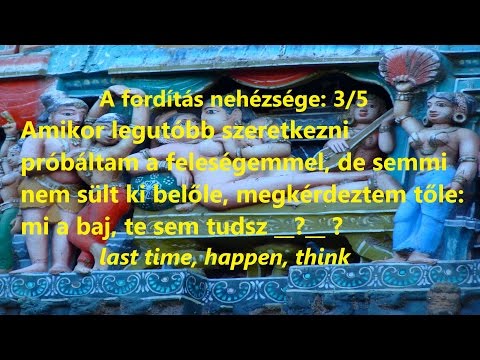
180. last time

felnőttes tartalom... vajon kitalálod-e, mi hiányzik? – ha ránézel a dőlt betűsökre és a nyelvtani segítségre, a fordításban még mindig lehet 2 (nyelvi) hibád :(


 segítség a nyelvtanhoz:
  * igeidők (videó)
  * sem, én sem, én is_mondatok

Wikipedia: The Kama Sutra (Sanskrit: कामसूत्र, Kāmasūtra) is an ancient Indian Hindu text written by Vātsyāyana. It is widely considered to be the standard work on human sexual behaviour in Sanskrit literature.
A portion of the work consists of practical advice on sexual intercourse. It is largely in prose, with many inserted anustubh poetry verses. "Kāma" which is one of the four goals of Hindu life, means desire including sexual desire the latter being the subject of the textbook, and "sūtra" literally means a thread or line that holds things together, and more metaphorically refers to an aphorism (or line, rule, formula), or a collection of such aphorisms in the form of a manual.
Contrary to western popular perception, the Kama Sutra is not exclusively a sex manual; it presents itself as a guide to a virtuous and gracious living that discusses the nature of love, family life and other aspects pertaining to pleasure oriented faculties of human life. Kama Sutra, in parts of the world, is presumed or depicted as a synonym for creative sexual positions; in reality, only 20% of Kama Sutra is about sexual positions. The majority of the book, notes Jacob Levy, is about the philosophy and theory of love, what triggers desire, what sustains it, how and when it is good or bad.
The Kama Sutra is the oldest and most notable of a group of texts known generically as Kama Shastra (Sanskrit: Kāma Śāstra).
Historians attribute Kamasutra to be composed between 400 BCE and 200 CE. John Keay says that the Kama Sutra is a compendium that was collected into its present form in the 2nd century CE...
...The most widely known English translation of the Kama Sutra was privately printed in 1883. It is usually attributed to renowned orientalist and author Sir Richard Francis Burton, but the chief work was done by the Indian archaeologist Bhagwan Lal Indraji, under the guidance of Burton's friend, the Indian civil servant Forster Fitzgerald Arbuthnot, and with the assistance of a student, Shivaram Parshuram Bhide. Burton acted as publisher, while also furnishing the edition with footnotes whose tone ranges from the jocular to the scholarly...

...An English translation by Wendy Doniger and Sudhir Kakar, an Indian psychoanalyst and senior fellow at Center for Study of World Religions at Harvard University, was published by Oxford University Press in 2002. Doniger contributed the Sanskrit expertise while Kakar provided a psychoanalytic interpretation of the text...

165. sex between

némi beleérzéssel kitalálhatod, melyik szó hiányzik kétszer is.
a fordításhoz komoly segítséget kapsz – ha így sem sikerül, izmosodnod kéne,
persze hogy az Off Course angollal :)


 segítség a nyelvtanhoz:
  * feltételes mód (videó)
  * képes, tud_mondatok

Wikipedia: An intersex human or other animal is one possessing any of several variations in sex characteristics including chromosomes, gonads, sex hormones, or genitals that, according to the UN Office of the High Commissioner for Human Rights, "do not fit the typical definitions for male or female bodies". Such variations may involve genital ambiguity, and combinations of chromosomal genotype and sexual phenotype other than XY-male and XX-female.
Intersex people were previously referred to as hermaphrodites, "congenital eunuchs", or even congenitally "frigid". Such terms have fallen out of favor; in particular, the phrase "hermaphrodite" is considered to be misleading, stigmatizing, and scientifically specious. Medical description of intersex traits as disorders of sex development has been controversial since the label was introduced in 2006.
Some intersex infants and children, such as those with ambiguous outer genitalia, are surgically or hormonally altered to create more socially acceptable sex characteristics. However, this is considered controversial, with no firm evidence of good outcomes. Such treatments may involve sterilization. Adults, including elite female athletes, have also been subjects of such treatment. Increasingly these issues are considered human rights abuses, with statements from international and national human rights and ethics institutions. Intersex organizations have also issued statements, including joint statements as part of an International Intersex Forum.

Participants at the third International Intersex Forum, Malta, in December 2013

In 2011, Christiane Völling became the first intersex person known to have successfully sued for damages in a case brought for non-consensual surgical intervention. In April 2015, Malta became the first country to outlaw non-consensual medical interventions to modify sex anatomy, including that of intersex people.
Intersex people may have any gender identity. Some intersex individuals may be raised as a girl or boy but then identify with another gender identity later in life, while most do not.

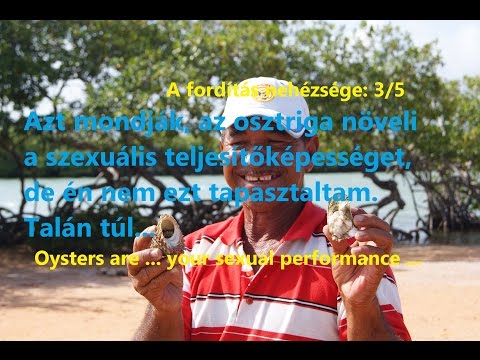
83. oysters


Wikipedia: Garry Emmanuel Shandling (November 29, 1949 – March 24, 2016) was an American comedian, actor, writer, producer and director. He was best known for his work in It's Garry Shandling's Show and The Larry Sanders Show.
Shandling died on March 24, 2016. The Los Angeles Police Department reported that he suddenly collapsed and was rushed to a hospital, suffering from an apparent medical emergency. He had suffered "a massive heart attack".
It's Garry Shandling's Show
Shandling and co-writer Alan Zweibel went on to create the surreal comedy series It's Garry Shandling's Show in 1985. It ran for 72 episodes on the Showtime cable television network through 1990. The edited reruns played on the Fox network beginning in 1988. Shandling wrote 15 episodes of the show.
The series subverted the standard sitcom format by having its characters openly acknowledge that they were all part of a TV show. Building on a concept that harked back to The George Burns and Gracie Allen Show, in which George Burns would frequently break the "fourth wall" and speak directly to the audience, Shandling's show went so far as to incorporate the audience and elements of the studio itself into the storylines, calling attention to the artifice of the show.
The show was nominated for four Emmy Awards, including one for Shandling. He won an American Comedy Award for Funniest Male Performance in a Series, and won four CableACE awards, two for Best Comedy Series. The show also won an award for Outstanding Achievement in Comedy from the Television Critics Association.