
Wikipedia: John Ruskin was the leading
English art critic of the Victorian era... Today, his ideas and
concerns are widely recognised as having anticipated interest in
environmentalism, sustainability and craft...
62. solution

segítség a nyelvtanhoz:
* összehasonlítás és fokozás_mondatok
Wikipedia: Milton Friedman (July 31,
1912 – November 16, 2006) was an American economist who received
the 1976 Nobel Memorial Prize in Economic Sciences for his research
on consumption analysis, monetary history and theory and the
complexity of stabilization policy. With George Stigler and others,
Friedman was among the intellectual leaders of the second generation
of Chicago price theory, a methodological movement at the University
of Chicago's Department of Economics, Law School, and Graduate School
of Business from the 1940s onward. Several students and young
professors that were recruited or mentored by Friedman at Chicago
went on to become leading economists; they include Gary Becker,
Robert Fogel, and Robert Lucas, Jr...
61. who knows
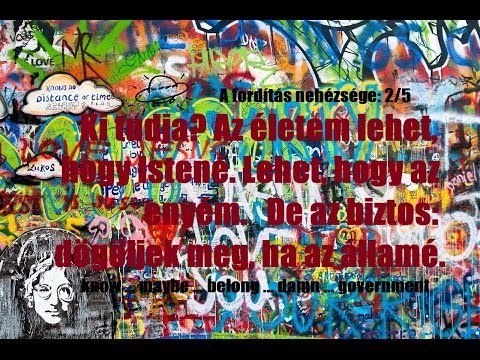
Segítség a nyelvtanhoz:
* igeidők-2: kivételek, érdekességek_mondatok
Wikipedia:
Art Hoppe (Arthur Watterson Hoppe, April 23, 1925 - February 1, 2000)
was a popular columnist for the San Francisco Chronicle for more than
40 years. He was known for satirical and allegorical columns that
skewered the self-important. Many columns featured whimsical
characters such as expert-in-all-things Homer T. Pettibone and a
presidential candidate named Nobody. Occasionally, Hoppe reined in
his humor for poignant columns on serious topics, such as "To
Root Against Your Country," a noted 1971 column against the
Vietnam War. Hoppe began at the Chronicle as a copy boy in 1949 and
was promoted to reporter before beginning his own column. At the peak
of its popularity, Hoppe's column appeared in the Chronicle five days
a week and was syndicated in more than 100 newspapers nationwide. His
close friends included fellow columnists Russell Baker and Art
Buchwald.
Hoppe
received the Lifetime Achievement Award from the National Society of
Newspaper Columnists in 1996. He died from complications of lung
cancer in February 2000, aged 74, survived by his wife Gloria and
four children.
60. MrPougnet
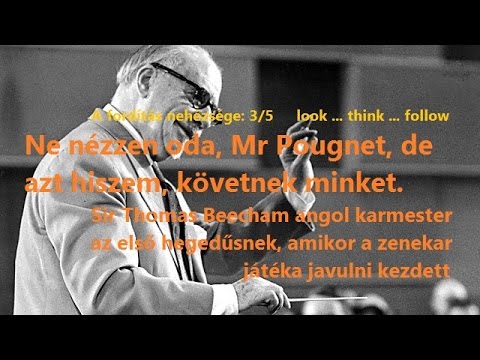
segítség a nyelvtanhoz:
* felszólítás (videó)
* felszólítás_mondatok
* igeidők (videó)
Wikipedia: Sir Thomas Beecham, 2nd
Baronet, CH (29 April 1879 – 8 March 1961) was an
English conductor and impresario best known for his association
with the London Philharmonic and the Royal
Philharmonicorchestras. He was also closely associated with
the Liverpool Philharmonic and Hallé orchestras.
From the early 20th century until his death, Beecham was a major
influence on the musical life of Britain and, according to the BBC,
was Britain's first international conductor...
...Beecham
has been much quoted. In 1929, the editor of a music journal wrote,
"The stories gathered around Sir Thomas Beecham are innumerable.
Wherever musicians come together, he is likely to be one of the
topics of conversation. Everyone telling a Beecham story tries to
imitate his manner and his tone of voice." A book, Beecham
Stories, was published in 1978 consisting entirely of his bons
mots and anecdotes about him. Some are variously attributed
to Beecham or one or more other people, including Arnold
Bax and Winston Churchill; Neville Cardus admitted to
inventing some himself. Among the Beecham lines that are
reliably attributed are, "A musicologist is a man who can read
music but can't hear it"; his maxim, "There are only
two things requisite so far as the public is concerned for a good
performance: that is for the orchestra to begin together and end
together; in between it doesn't matter much"; and his
remark at his 70th birthday celebrations after telegrams were read
out from Strauss, Stravinsky and Sibelius: "Nothing from
Mozart?"
Jean Pougnet (20 July 1907 – 14
July 1968) was a Mauritian-born concert violinist and
orchestra leader, of British nationality, who was highly
regarded in both the lighter and more serious classical repertoire
during the first half of the twentieth century. He was leader of
the London Philharmonic Orchestra from 1942 to 1945.
59. recognize

segítség a nyelvtanhoz:
* igeidők (videó)
Wikipedia: Oscar Fingal O'Flahertie
Wills Wilde (16 October 1854 – 30 November 1900) was an
Irish playwright, novelist, essayist, and poet. After writing in
different forms throughout the 1880s, he became one of London's most
popular playwrights in the early 1890s. He is remembered for his
epigrams, his novel The Picture of Dorian Gray, his plays, as
well as the circumstances of his imprisonment and early death.
THE OFFICIAL WEBSITE OF OSCAR WILDE:
http://www.cmgww.com/historic/wilde/
MORE QUOTES:
58. last night

segítség a nyelvtanhoz:
* igeidők (videó)
Wikipedia:
Phyllis Ada Driver (July 17, 1917 – August 20, 2012), better
known as Phyllis Diller, was an American stand-up comedian,
actress, singer, dancer, and voice artist, best known for her
eccentric stage persona, her self-deprecating humor, her wild hair
and clothes, and her exaggerated, cackling laugh.
Diller
was a groundbreaking stand-up comic – one of the first woman comics
to become a household name in the U.S. She paved the way for Joan
Rivers, Roseanne Barr and Ellen Degeneres, among
others, who credit her influence. Diller had a large gay
following and is considered a gay icon. She was also one of the
first celebrities to openly champion plastic surgery, for which she
was recognized by the industry.
Diller
worked in more than 40 films, beginning with 1961's Splendor in
the Grass. She appeared in many television series, often in cameos,
but also including her own short-lived sitcom and variety show. Some
of her credits include The Night Gallery, The Muppet Show, The
Love Boat, Cybill, and Boston Legal, plus eleven seasons of The
Bold and the Beautiful. Her voice-acting roles included the monster's
wife in Mad Monster Party, the Queen in A Bug's Life,
Granny Neutron in The Adventures of Jimmy Neutron: Boy Genius,
and Thelma Griffin in Family Guy.
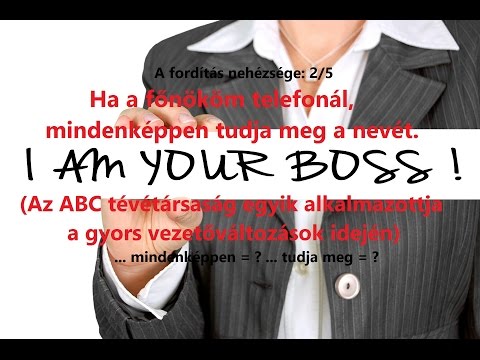
56. amazed
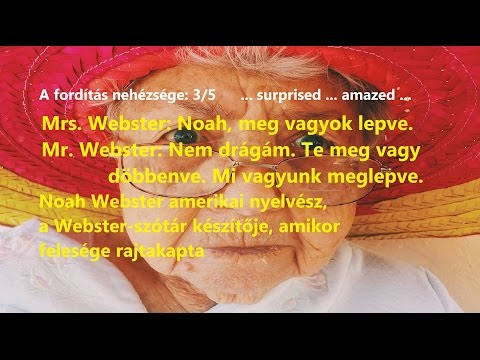
segítség a nyelvtanhoz:
* kiemelés a mondatban_mondatok
Wikipedia: Noah Webster, Jr. (October
16, 1758 – May 28, 1843), was an American lexicographer,
textbook pioneer, English-language spelling reformer, political
writer, editor, and prolific author. He has been called the "Father
of American Scholarship and Education". His blue-backed speller
books taught five generations of American children how to spell and
read, secularizing their education. According to Ellis (1979) he
gave Americans "a secular catechism to the
nation-state."
Webster's name has become synonymous
with "dictionary" in the United States, especially the
modern Merriam-Webster dictionary that was first published
in 1828 as An American Dictionary of the English Language.
He was one of the Founding
Fathers of the United States...
... In 1806, Webster published his
first dictionary, A Compendious Dictionary of the English
Language. In 1807 Webster began compiling an expanded and fully
comprehensive dictionary, An American Dictionary of the English
Language; it took twenty-six years to complete. To evaluate the
etymology of words, Webster learned twenty-eight languages,
including Old English (Anglo-Saxon), Gothic, German, Greek,
Latin, Italian, Spanish, French, Dutch, Welsh, Russian, Hebrew,
Aramaic, Persian, Arabic, and Sanskrit. Webster hoped to
standardize American speech, since Americans in different parts of
the country used different languages. They also spelled, pronounced,
and used English words differently...
55. God bless
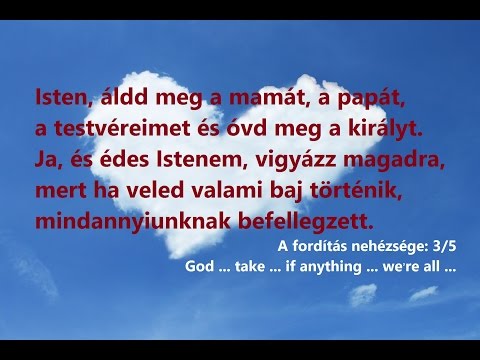
Segítség a nyelvtanhoz:
* felszólítás (videó)
* felszólítás_mondatok
* igeidők-2: kivételek, érdekességek_mondatok
* feltételes mód (videó)
* feltételes mód_mondatok
Wikipedia:
Adlai Ewing Stevenson II (February 5, 1900 – July 14, 1965)
was an American politician and diplomat, noted for his intellectual
demeanor, eloquent public speaking, and promotion of liberal causes
in the Democratic Party. He served as the 31st Governor of
Illinois, and received the Democratic Party's nomination for
president in 1952 even though he had not campaigned in the
primaries. John Frederick Martin says party leaders selected him
because he was "more moderate on civil rights than Estes
Kefauver, yet nonetheless acceptable to labor and urban machines —
so a coalition of southern, urban, and labor leaders fell in behind
his candidacy in Chicago."
...
The governor proved to be a popular public speaker, gaining a
national reputation as an intellectual, with a self-deprecating sense
of humor to match. One example came when the Illinois legislature
passed a bill (supported by bird lovers) declaring that cats roaming
unescorted was a public nuisance. Stevenson vetoed the bill, and sent
this public message regarding the veto: "It is in the nature of
cats to do a certain amount of unescorted roaming...the problem of
cat versus bird is as old as time. If we attempt to solve it by
legislation who knows but what we may be called upon to take sides as
well in the age old problem of dog versus cat, bird versus bird, or
even bird versus worm. In my opinion, the State of Illinois and its
local governing bodies already have enough to do without trying to
control feline delinquency. For these reasons, and not because I love
birds the less or cats the more, I veto and withhold my approval from
Senate Bill No. 93."
54. left wing

segítség a nyelvtanhoz:
* általános alany_mondatok
* félsegédigék_mondatok
Wikipedia: Robert Keith "Bob"
Rae (born August 2, 1948) is
a lawyer, negotiator, public speaker and former Canadian politician.
He was the Member of Parliament for Toronto Centre and was
the interim leader of the Liberal Party of Canada from
2011 to 2013. He was previously leader of the Ontario New
Democratic Party and the 21st Premier of Ontario, from
1990-1995.
53. men
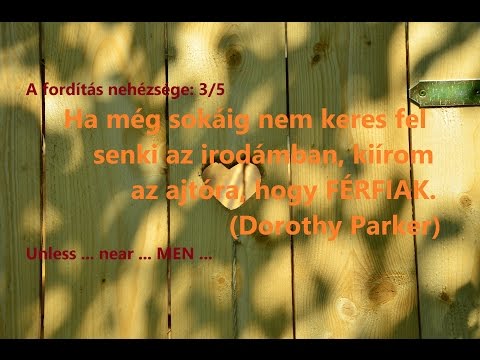
segítség a nyelvtanhoz:
* unless_mondatok
* igeidők-2: kivételek, érdekességek_mondatok
(www.biography.com)
Dorothy Parker was the sharpest wit of the Algonquin Round Table, as well as a master of short fiction and a blacklisted screenwriter.
Dorothy Parker was the sharpest wit of the Algonquin Round Table, as well as a master of short fiction and a blacklisted screenwriter.
In addition to her writing, Dorothy
Parker was a noted member of the New York literary scene in 1920s.
She formed a group called the Algonquin Round Table with writer
Robert Benchley and playwright Robert Sherwood. This artistic crowd
also included such members as The New Yorker founder Harold
Ross, comedian Harpo Marx, and playwright Edna Ferber among others.
The group took its name from its hangout—the Algonquin Hotel, but
also also known as the Vicious Circle for the number of cutting
remarks made by its members and their habit of engaging in
sharp-tongued banter.
(excerpt from an interview with Dorothy Parker by Marion Capron – www.theparisreview.org)
INTERVIEWER: That’s not showing much
respect for your fellow women, at least not the writers.
PARKER: As artists they’re not, but
as providers they’re oil wells; they gush. Norris said she never
wrote a story unless it was fun to do. I understand Ferber whistles
at her typewriter. And there was that poor sucker Flaubert rolling
around on his floor for three days looking for the right word. I’m
a feminist, and God knows I’m loyal to my sex, and you must
remember that from my very early days, when this city was scarcely
safe from buffaloes, I was in the struggle for equal rights for
women. But when we paraded through the catcalls of men and when we
chained ourselves to lampposts to try to get our equality—dear
child, we didn’t foresee those female writers. Or Clare
Boothe Luce, or Perle Mesta, or Oveta Culp Hobby.
INTERVIEWER: You have an extensive
reputation as a wit. Has this interfered, do you think, with your
acceptance as a serious writer?
PARKER: I don’t want to be classed as
a humorist. It makes me feel guilty. I’ve never read a good tough
quotable female humorist, and I never was one myself. I couldn’t do
it. A “smartcracker” they called me, and that makes me sick and
unhappy. There’s a hell of a distance between wisecracking and wit.
Wit has truth in it; wisecracking is simply calisthenics with words.
I didn’t mind so much when they were good, but for a long time
anything that was called a crack was attributed to me—and then they
got the shaggy dogs.
52. make love
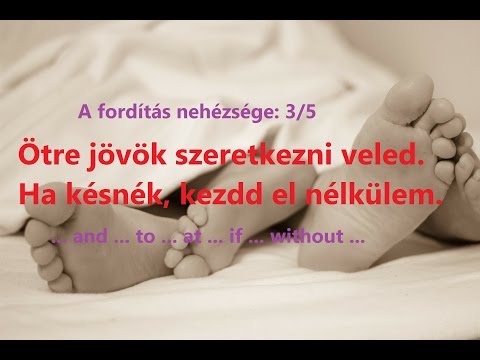
segítség a nyelvtanhoz:
* igeidők (videó)
* feltételes mód (videó)
* feltételes mód_mondatok
* to + főnévi igenév_mondatok
Wikipedia: Tallulah Brockman
Bankhead (January 31, 1902 – December 12, 1968) was an
American actress of the stage and screen, and a
reputed libertine. Bankhead was known for her husky voice,
outrageous personality, and devastating wit. Originating some of the
twentieth century theater's preeminent roles in comedy and melodrama,
she gained acclaim as an actress on both sides of the Atlantic.
Bankhead became an icon of the tempestuous, flamboyant actress, and
her unique voice and mannerisms are often subject to imitation and
parody ...
... In her personal life, Bankhead
struggled with alcoholism and drug addiction, and was infamous for
her uninhibited sex life. Despite her vices, Bankhead was capable of
great kindness and generosity to those in need, supporting
disadvantaged foster children and helping several families escape
the Spanish Civil War and World War II. Bankhead was inducted
into the American Theater Hall of Fame in 1972, and
the Alabama Women's Hall of Fame in 1981. Upon her
death, Bankhead was credited with nearly 300 film, stage, television,
and radio roles. She is regarded as one of the 20th century
theatre's great Leading Ladies.
51. Marilyn
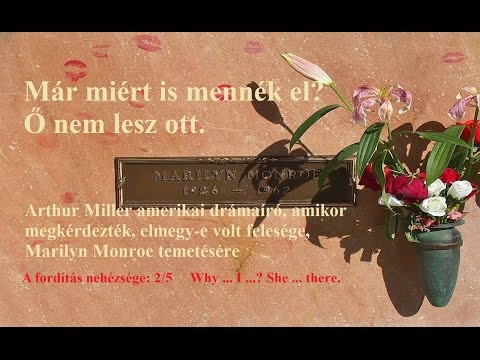
segítség a nyelvtanhoz:
* kellene, nem szabadna (videó)
* kellene, nem szabadna_mondatok
* igeidők (videó)
60 Minutes Overtime shares one of our
favorite stories from the 60 Minutes archives. Originally aired on
November 15, 1987, it's a revealing interview between Mike Wallace
and the man who, in many respects, was an unlikely match for Monroe:
the star's husband for 5 years, Pulitzer Prize-winning playwright
Arthur Miller.
His name graced the pages of the
theater section, while hers was splashed across tabloids and gossip
columns. But in fact, Miller said, Monroe was the innocent one,
particularly as she moved into the role of wife and step-mother. But
at the end of the day, "she wanted to be a star," Miller
told Wallace, and that's ultimately what killed her.
Arthur Miller was 72 years old at the
time of the interview, and 25 years had passed since the death of his
former wife. Nevertheless, Wallace managed to strike a chord with
Miller when the two men reflected on Monroe:
WALLACE: Your face changes when you
talk about her.
MILLER: Excuse me?
WALLACE: Your face changes when you
talk about her.
MILLER: In what way?
WALLACE: Well I think you still –
those were tough years. Wonderful years and terrible years.
MILLER: Sure they were. Oh, there was a
lot of pain certainly for her and certainly for me.
WALLACE: Why? What did it do to you?
MILLER: Well, it's a defeat. It always
is.
During their relationship, Miller wrote
the screenplay for "The Misfits," with the lead role played
by Monroe. She played a wounded young woman, who falls in love with a
much older man. It would be her last film.
Despite the success of 1961's "The
Misfits," Miller's marriage to Monroe had been struggling for
months, and the couple ultimately separated. In addition to drug and
alcohol dependency, Monroe had endured several miscarriages and was
battling depression.
"I guess to be frank about it, I
was taking care of her. I was trying to keep her afloat," Miller
told Wallace. "She was a super-sensitive instrument, and that's
exciting to be around until it starts to self-destruct."
When Wallace asked Miller if he knew
Monroe's life was destined for disaster, he said, "I didn't know
it was doomed, but I certainly felt it had a good chance to be."
Less than two years later, Monroe was found dead at the age of 36 in
her California home.
(from CBS 60 minutes archives)
50. RIP Bowie

Segítség a nyelvtanhoz:
* igeidők-2: kivételek, érdekességek_mondatok
* milyen szép! micsoda férfi!_mondatok
* általános alany_mondatok
David Bowie was the Picasso of pop. He was an innovative, visionary, restless artist: the ultimate ever-changing postmodernist.
Along
with the Beatles, Stones and Elvis Presley, Bowie defined what pop
music could and should be. He brought art to the pop party, infusing
his music and performances with the avant-garde ideas of Merce
Cunningham, John Cage and Andy Warhol.
He
turned pop in a new direction in 1972 with the introduction of his
alter ego Ziggy Stardust. Glam rock was the starting point, but Ziggy
was much more than an eyeliner-wearing maverick: he was a truly
theatrical character that at once harked backed to pre-War European
theatre while anticipating 1980s androgyny and today's discussions
around a transgender spectrum.
He
was a great singer, songwriter, performer, actor, producer and
collaborator. But beyond all that, at the very heart of the matter,
David Bowie was quite simply - quite extraordinarily – cool.
(Will
Gompertz, BBC Arts editor)
49. 4pm

segítség a nyelvtanhoz:
Wikipedia: Henry "Henny"
Youngman (original Yiddish surname Yungman; 16 March 1906 –
24 February 1998) was a British-born American comedian and violinist
famous for his mastery of the "one-liner". His best known
one-liner was "Take my wife...please".
In a time when many comedians told
elaborate anecdotes, Youngman's routine consisted of telling simple
one-liner jokes, occasionally with interludes of violin playing.
These depicted simple, cartoon-like situations, eliminating lengthy
build-ups and going straight to the punch line. He was known as "The
King of the One Liners", a title conferred to him by
columnist Walter Winchell. A stage performance by Youngman
lasted only fifteen to twenty minutes but contained dozens of jokes
in rapid-fire succession.
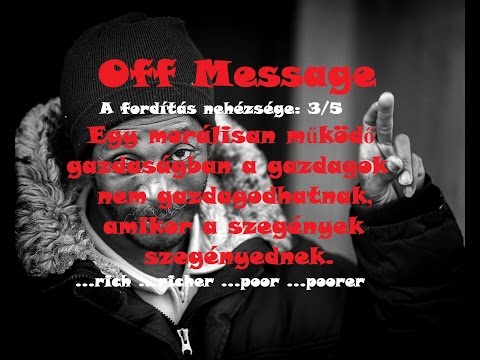
Off Message: poor
off message: kb. a hivatalos állásponttal nem egyező, attól eltérő véleménynyilvánítás, nyilatkozat, kijelentés
Segítség a nyelvtanhoz:
* kellene, nem szabadna (videó)
* kellene, nem szabadna_mondatok
* összehasonlítás és fokozás_mondatok
Wikipedia: Malachi Brendan Martin (Irish: Maolsheachlann Breandán Ó Máirtín; July 23, 1921 – July 27, 1999), occasionally writing under the pseudonym Michael Serafian, was an Irish Catholic priest and writer on the Catholic Church. Originally ordained as a Jesuit priest, he became Professor of Palaeography at the Vatican's Pontifical Biblical Institute. From 1958 he served as secretary to Cardinal Bea during preparations for the Second Vatican Council. Disillusioned by reforms, he asked to be released from certain of his Jesuit vows in 1964 and moved to New York City, where he later became an American citizen. His 17 novels and non-fiction books were frequently critical of the Catholic Church, which he believed had failed to act on the third prophecy revealed by the Virgin Mary at Fátima.[1] Among his most significant works were The Scribal Character of The Dead Sea Scrolls (1958) and Hostage To The Devil (1976) which dealt with satanism, demonic possession, and exorcism. The Final Conclave(1978) was a warning against alleged Soviet spies in the Vatican.
Segítség a nyelvtanhoz:
* kellene, nem szabadna (videó)
* kellene, nem szabadna_mondatok
* összehasonlítás és fokozás_mondatok
Wikipedia: Malachi Brendan Martin (Irish: Maolsheachlann Breandán Ó Máirtín; July 23, 1921 – July 27, 1999), occasionally writing under the pseudonym Michael Serafian, was an Irish Catholic priest and writer on the Catholic Church. Originally ordained as a Jesuit priest, he became Professor of Palaeography at the Vatican's Pontifical Biblical Institute. From 1958 he served as secretary to Cardinal Bea during preparations for the Second Vatican Council. Disillusioned by reforms, he asked to be released from certain of his Jesuit vows in 1964 and moved to New York City, where he later became an American citizen. His 17 novels and non-fiction books were frequently critical of the Catholic Church, which he believed had failed to act on the third prophecy revealed by the Virgin Mary at Fátima.[1] Among his most significant works were The Scribal Character of The Dead Sea Scrolls (1958) and Hostage To The Devil (1976) which dealt with satanism, demonic possession, and exorcism. The Final Conclave(1978) was a warning against alleged Soviet spies in the Vatican.
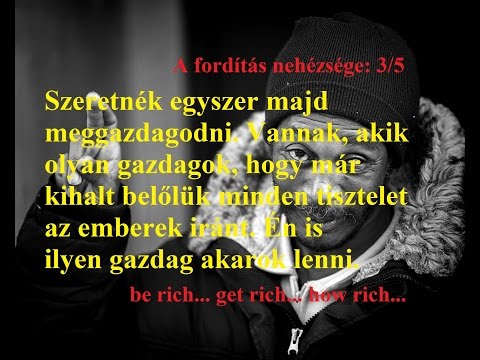
48. rich
segítség a nyelvtanhoz:
* kiemelés a mondatban_mondatok
Wikipedia: Rita Rudner (born
September 17, 1953) is an American comedian, writer and actress.
Beginning her career as a Broadway dancer, Rita Rudner noticed the
lack of female comedians in New York City and turned her stage
presence to stand-up comedy where she’s flourished for over three
decades. Her performance on a variety of HBO specials and numerous
appearances on the Tonight Show with Johnny Carson, helped establish
Rudner as one of the premiere female comics to emerge from the comedy
boom of the 1980s. After extensive touring throughout the past 20
years, Rudner has created a steady career performing in Las Vegas at
the Venetian Hotel while residing in Southern California.
top 3 quotes in 2015: (1) Sucking positive thinking: tragic

Segítség a nyelvtanhoz:
* képes, tud_mondatok
* olyan, szóval, úgyhogy_mondatok
Wikipedia: Ashleigh Ellwood Brilliant (born 9 December 1933) is an author and syndicated cartoonist born in London, UK, and living in Santa Barbara, California, USA. He is best known for his Pot-Shots, single-panel illustrations with one-line humorous remarks, which began syndication in the United States of America in 1975. Brilliant achieved American citizenship in 1969.
The Wall Street Journal described
him in a 1992 profile as "history's only full time, professional
published epigrammatist."
At one time, there was some confusion
and controversy as to the ownership and recognition of his
distinctive art form. In a copyright infringement suit filed by
Brilliant, a United States federal judge ruled that while short
phrases are not eligible for copyright, Brilliant's works
were epigrams and therefore copyrightable (Brilliant v. W.
B. Productions Inc., 1979).
While Brilliant employs a self-imposed
limit of 17 words per epigram, he has actually written and published
41 with 18 words and one with 19 words (By the miracle of teaching, I
can give you some of my ability, without losing any of it myself.)
Brilliant is frequently asked about his
real last name, of which he says: As far as I know, the name
Brilliant is of Russian/Polish/Jewish origin, and is akin to other
Jewish names related to precious metals and jewels, e. g. Gold,
Silver, Diamond, Ruby, Pearl. (One meaning of brilliant is a kind of
diamond.) These in turn relate to the kinds of trades in which many
European Jews were engaged when, in the time of Napoleon, they were
first required to take surnames.
top 3 quotes in 2015: (3) straight people

tudod-e
kikről beszél Michael?... a fordításnak akkor ugorj neki, ha már
megnézted a műveltetést a mondattárban (vagy nagyképű vagy) :)
segítség a nyelvtanhoz:
* műveltetés (videó)
* műveltetés_mondatok
* igeidők (videó)
Forrás: Meleg ABC, Katalizátor Könyvkiadó, 2014.
Válogatta, fordította és szerkesztette: Zalotay Melinda
Wikipedia: Heteronormativity
denotes or relates to a world view that promotes heterosexuality as
the normal or preferred sexual orientation for people to have. It can
assign strict gender roles to males and females. The term was
popularized by Michael Warner in 1991. Many gender and sexuality
scholars argue that compulsory heterosexuality, a continual and
repeating reassertion of hetersoexual norms, is facet of
heterosexism. Compulsory heterosexuality is the idea that female
heterosexuality is both assumed and enforced by a patriarchal
society. Heterosexuality is then viewed as the natural inclination or
obligation by both sexes. Consequently, anyone who differs from the
normalcy of heterosexuality is deemed deviant or abhorrent.
Heterosexism
is a form of bias or discrimination in favor of opposite-sex
sexuality and relationships. It may include an assumption that
everyone is heterosexual and may involve a varied level of
discrimination against gays, lesbians, bisexuals, heteroflexibles, or
transgender individuals.
Straight pride is a slogan that
arose in the late 1980s and early 1990s and has been used primarily
by social conservative groups as a political stance and strategy. The
term is described as a response to gay pride adopted by various LGBT
groups in the early 1970s or to the accommodations provided to gay
pride initiatives.
 This
image is often used on Straight Pride T-shirts
This
image is often used on Straight Pride T-shirts
A
heterosexual ally is a heterosexual person who supports equal civil
rights for persons with non-heterosexual orientations. Heterosexual
allies may also supportLGBT social movements.
45. commandments

segítség a nyelvtanhoz:
* feltételes mód (videó)
* feltételes mód_mondatok
* some, any, no és none
Wikipedia: The Ten Commandments, also known
as the Decalogue, are a set of commandments which the Bible
describes as having been given to the Israelites by God
at biblical Mount Sinai. The Ten Commandments are listed twice
in the Hebrew Bible, first at Exodus 20:1–17, and then
at Deuteronomy 5:4–21. Both versions state that God
inscribed them on two stone tablets, which he gave
to Moses. According to New Testament writers, the Ten
Commandments are clearly attributed to Moses (Mark 7:10, see
also John 7:19).
Modern scholarship has found likely
influences in Hittite and Mesopotamian laws and
treaties, but is divided over exactly when the Ten Commandments were
written and who wrote them.
The commandments include instructions
to worship only God, to honour parents, and to keep
the sabbath; as well as prohibitions
against idolatry, blasphemy, murder, adultery, theft, dishonesty,
and coveting. Different religious groups follow different
traditions for interpreting and numbering them.
44. woman

segítség a nyelvtanhoz:
* fordított szórend
* mindegyik, az összes
Origin
(http://www.phrases.org.uk)
Behind
every great man there's a great woman – This has been adopted as a
feminist slogan. The origins are uncertain, but it's certainly much
older than the Women's Movement of the 1960s/70s, which spawned other
such slogans; for example, 'a woman needs a man like a fish needs a
bicycle.'
The
first printed citation I can find is from the Texas newspaper The
Port Arthur News, from February 1946. This was headed - "Meryll
Frost - 'Most courageous athlete of 1945'": "As he received
his trophy, the plucky quarterback unfolded the story of how he 'came
back'. He said 'They say behind every great man there's a woman.
While I'm not a great man, there's a great woman behind me.'"
The
use of the phrase in that quotation suggests it was well-known at the
time, and may be much older than 1945.
The
use of the phrase received a boost in 1985 with the release of The
Eurythmics' song - Sisters Are Doin' It For Themselves:
Now,
there was a time,
when they used to say,
that behind ev'ry great man,
there had to be a great woman.
But oh, in these times of change,
you know that it's no longer true.
So we're comin' out of the kitchen,
'cause there's something we forgot to say to you.
We say, Sisters are doin' it for themselves
that behind ev'ry great man,
there had to be a great woman.
But oh, in these times of change,
you know that it's no longer true.
So we're comin' out of the kitchen,
'cause there's something we forgot to say to you.
We say, Sisters are doin' it for themselves
43. proud

segítség a nyelvtanhoz:
* feltételes mód (videó)
* feltételes mód_mondatok
* vonatkozó mellékmondatok_mondatok
Wikipedia: Laurence Johnston Peter (September 16, 1919 – January 12, 1990) was a Canadian educator and "hierarchiologist", best known to the general public for the formulation of the Peter Principle.
He was born in Vancouver, British
Columbia, and began his career as a teacher in Vancouver in 1941. He
received the degree of Doctor of Education from Washington
State University in 1963.
In 1966, Peter moved to California,
where he became an Associate Professor of Education, Director of the
Evelyn Frieden Centre for Prescriptive Teaching, and Coordinator of
Programs for Emotionally Disturbed Children at the University of
Southern California.
He became widely famous in 1968, on the
publication of The Peter Principle, in which he states: "In
a hierarchy every employee tends to rise to his level of incompetence
... in time every post tends to be occupied by an employee who is
incompetent to carry out its duties ... Work is accomplished by those
employees who have not yet reached their level of incompetence."
Another notable quotation of his is
that the "noblest of all dogs is the hot-dog; it feeds the hand
that bites it."
From 1985 to his death in 1990, Peter
attended and was involved in management of the Kinetic Sculpture
Race in Humboldt County, California. He proposed an award for
the race, titled "The Golden Dinosaur Award" which has been
handed out every year since to the first sculptural machine to
utterly break down immediately after the start.
42. opera

segítség a nyelvtanhoz:
* valamikortól, valameddig_mondatok
ain't:
az am not, is not, are not, has not, have not nem sztenderd, igen laza
nyelvi változata
Colloquialism: hétköznapi/társalgási nyelvi kifejezés (a word or phrase that is used in conversation but not in formal
speech or writing).
Az It ain't over until the fat lady sings körülbelül olyasmit jelent, hogy még semmi sem dőlt el, még bármi megtörténhet, még nincs vége a játszmának, ez még nem egy lejátszott mérkőzés.
Az It ain't over until the fat lady sings körülbelül olyasmit jelent, hogy még semmi sem dőlt el, még bármi megtörténhet, még nincs vége a játszmának, ez még nem egy lejátszott mérkőzés.
Wikipedia:
It ain't over till the fat lady sings is
a colloquialism and has been classified as a proverb.
It means that one should not presume to know the outcome of an event
which is still in progress. More specifically, the phrase is used
when a situation is (or appears to be) nearing its conclusion. It
cautions against assuming that the current state of an event is
irreversible and clearly determines how or when the event will end.


Feliratkozás:
Bejegyzések
(
Atom
)