Angolszász idézetek fordítással, Off Course nyelvtan videókkal és mondatgyűjteménnyel ______________________www.facebook.com/offcourseangol_____________________
szerény
képzelőerőddel is ki fogod találni, melyik szó hiányzik (adok
dőlt betűs segítséget). a fordításban viszont szinte biztosan
elkövetsz egy hibát, még ha haladósnak is érzed magad...
Muhammad
Ali, the silver-tongued boxer and civil rights champion who famously
proclaimed himself "The Greatest" and then spent a lifetime
living up to the billing, is dead.
Ali
died Friday at a Phoenix-area hospital, where he had spent the past
few days being treated for respiratory complications, a family
spokesman confirmed to NBC News. He was 74.
"After
a 32-year battle with Parkinson's disease, Muhammad Ali has passed
away at the age of 74. The three-time World Heavyweight Champion
boxer died this evening," Bob Gunnell, a family spokesman, told
NBC News...
...In
recent years, Ali's health began to suffer dramatically. There was a
death scare in 2013, and last year he was rushed to the hospital
after being found unresponsive. He recovered and returned to his new
home in Arizona.
In
his final years, Ali was barely able to speak. Asked to share his
personal philosophy with NPR in 2009, Ali let his wife read his
essay: "I never thought of the possibility of failing, only of
the fame and glory I was going to get when I won," Ali wrote. "I
could see it. I could almost feel it. When I proclaimed that I was
the greatest of all time, I believed in myself, and I still do."
kitalálod-e, miért nincs
jelentősége –
Samuel Johnson szerint? (szerinted igaza
van?!) a fordítással komolyan tesztelheted magad, vajon tényleg
haladó vagy-e (vagy csak beképzelt)...
Wikipedia:
Samuel Johnson (18 September 1709 [O.S. 7 September] – 13 December
1784), often referred to as Dr Johnson, was an English writer who
made lasting contributions to English literature as a poet, essayist,
moralist, literary critic, biographer, editor and lexicographer.
Johnson was a devout Anglican and committed Tory, and has been
described as "arguably the most distinguished man of letters in
English history"...
In 1746, a group of publishers
approached Johnson with an idea about creating an authoritative
dictionary of the English language. A contract with William Strahan
and associates, worth 1,500 guineas, was signed on the morning of 18
June 1746. Johnson claimed that he could finish the project in three
years. In comparison, the Académie Française had forty scholars
spending forty years to complete their dictionary, which prompted
Johnson to claim, "This is the proportion. Let me see; forty
times forty is sixteen hundred. As three to sixteen hundred, so is
the proportion of an Englishman to a Frenchman." Although he did
not succeed in completing the work in three years, he did manage to
finish it in eight. Some criticised the dictionary, including Thomas
Babington Macaulay, who described Johnson as "a wretched
etymologist," but according to Bate, the Dictionary "easily
ranks as one of the greatest single achievements of scholarship, and
probably the greatest ever performed by one individual who laboured
under anything like the disadvantages in a comparable length of
time."...
...The Dictionary was finally
published in April 1755, with the title page acknowledging that
Oxford had awarded Johnson a Master of Arts degree in anticipation of
the work. The dictionary as published was a huge book. Its pages were
nearly 18 inches (46 cm) tall, and the book was 20 inches (51 cm)
wide when opened; it contained 42,773 entries, to which only a few
more were added in subsequent editions, and it sold for the
extravagant price of £4 10s, perhaps the rough equivalent of £350
today. An important innovation in English lexicography was to
illustrate the meanings of his words by literary quotation, of which
there were approximately 114,000. The authors most frequently cited
include William Shakespeare, John Milton and John Dryden. It was
years beforeJohnson's Dictionary, as it came to be known, turned a
profit. Authors' royalties were unknown at the time, and Johnson,
once his contract to deliver the book was fulfilled, received no
further money from its sale. Years later, many of its quotations
would be repeated by various editions of the Webster's Dictionary and
the New English Dictionary.
ha elmúltál 18, sőt, akkor
kitalálhatod, mi lehet a hiányzó szó... segíthet, ha elárulom,
hogy a forrás: Woody Allen?... aztán a fordításhoz adok kis
segítséget, de csak akkor ugorj neki, ha haladó (vagy nagyképű)
vagy :)
Gonna
tell a love story now, 'cause you have background material on me. Ah,
this occurred before I was married, a long time ago, out in
Manhattan, I was in Manhattan. I was at City Center, this was ages
ago, I was watching a ballet at City Center, and I'm not a ballet fan
at all, but they were doing the dying swan, and there was a rumour,
that some bookmakers had drifted into town from upstate New York, and
that they had fixed the ballet. Apparently there was a lot of money
bet on the swan to live. And I look at the box, and I see a girl, and
my weak spot is women, ah, so I always think someday they're gonna
make me a birthday party, and wheel out a tremendous birthday cake,
and a giant, naked woman is gonna leap out of the cake and hurt me
and leap back in the cake.
So
I pick up this girl, I was very glib, and she was a brilliant girl,
she was a Bennington girl, studying at Bennington to be a woman male
nurse at a four-year program, working on a term paper on the
increasing incidents of heterosexuality amongst homosexuals. The girl
was a swinger, however, I must....The girl was brought up in Darien,
Conneticut, and when she was younger, she had a little brother about
six years old, eight years...his parents sent the kid to military
school. And while he was there, he stole jam or something, and they
caught him, and they wanted to do things right, 'cause it was
military school, so they held a court martial there. They found the
kid guilty. They shot him. They returned to his parents half the
tuition.
Meanwhile,
I was running amok with his sister, his sister was fabulous, she was
a great, great, blonde, and she had tatooed on the inner surface of
her thigh, the words 'Bird lives', which, unfortunately, I was never
privileged to see in the relationship, but had it been printed in
Braille, I would have had a great thing going with her. We used to go
up to her apartment late at night, and all her beatnik friends would
be sitting crosslegged on each other there, and they would be trying
to make opium out of the poppies given out by veterans on street
corners. She used to plug in her twelve and a half dollar hi-fi set,
y'know, with the teakwood needle, and put on the record albums on of
Marcel Marceau, y'know, just...
She
crushed me, I...Every time I tell the story, I'm reminded...I was
what you would call, not a intellectual, up to her...she was...I was
thrown out of college, and when I was thrown out of college I got a
job on Madison Avenue in New york, a real dyed-in-the-wool
advertising agency on Madison Avenue, wanted a man to come in, and
they pay him ninetyfive dollars a week, and to sit in their office,
and to look jewish. They wanted to prove to the outside world, that
they would hire minority groups, y'know. So I was the one they hired,
y'know. I was the show jew at the agency. I tried to look jewish
desperately, y'know. I used to read my memos from right to left all
the time. They fired me finally, 'cause I took off too many jewish
holidays.
na,
mit gondolsz, hogy fejezi be ezt egy istentelenül profi
politikus?... és hogyan oldja meg, hogy – nő létére – ne
kelljen a „he” személyes névmást használnia? nem a nyelvtan
itt a nehéz :)
Wikipedia:
Margaret Hilda Thatcher, Baroness Thatcher, LG, OM, PC, FRS, FRIC
(née Roberts; 13 October 1925 – 8 April 2013) was a British
stateswoman and politician who was the Prime Minister of the United
Kingdom from 1979 to 1990 and the Leader of the Conservative Party
from 1975 to 1990. She was the longest-serving British Prime Minister
of the 20th century and is currently the only woman to have held the
office. A Soviet journalist dubbed her the "Iron Lady", a
nickname that became associated with her uncompromising politics and
leadership style. As Prime Minister, she implemented policies that
have come to be known as Thatcherism.
Originally
a research chemist before becoming a barrister, Thatcher was elected
Member of Parliament (MP) for Finchley in 1959. Edward Heath
appointed her Secretary of State for Education and Science in his
1970 government. In 1975, Thatcher defeated Heath in the Conservative
Party leadership election to become Leader of the Opposition and
became the first woman to lead a major political party in the United
Kingdom. She became Prime Minister after winning the 1979 general
election...
...Thatcher
became Prime Minister on 4 May 1979. Arriving at 10 Downing Street,
she said, in a paraphrase of St. Francis of Assisi's prayer Make Me
an Instrument of Your Peace:
Where
there is discord, may we bring harmony. Where there is error, may we
bring truth. Where there is doubt, may we bring faith. And where
there is despair, may we bring hope.
Sean
O'Faolain, an Irish writer who was considered a master of the short
story, died on Saturday in the Dublin nursing home where he had lived
for two years. He was 91 years old...
...Mr.
O'Faolain, whose original name was John Francis Whelan, was born in
County Cork on Feb. 22, 1900, the son of a constable. "From an
early age he was inhibited," Gordon Henderson wrote in his
Dictionary of Literary Biography, by "his father's unquestioning
respect for authority, his mother's excessive piety, and the
preoccupation both had with rising above their peasant-farmer
origins."...
...For
more than 60 years, Mr. O'Faolain (pronounced oh-FAY-lawn) won over
readers with short stories that were known for their artful blend of
lyricism, humor and irony. A prolific writer, he also wrote novels,
biographies of leading Irish figures, plays and travelogues...
..."As
I see it," he said, "a short story, if it is a good story,
is like a child's kite -- a small wonder, a brief, bright moment."
Ireland With Some Irony...
..."Everything
I write is romantic. But I know too that I have to put in -- that my
only hope of sanity and balance is to put in -- irony. Irony is the
only element that saves me from being soppy."...
...The
most traumatic event of his youth was the Easter rebellion of 1916.
He first opposed the uprising, but soon became enraged by the
brutality of the British forces in crushing it and executing its
leaders. He studied Gaelic, changed his name and joined in
anti-British activities, but avoided extreme violence, observing
later, "To have cast me for the role of a gunman would have been
like casting me as a bull-fighter." Stories of the Troubles...
..."Like
Joyce and O'Connor," Gordon Henderson wrote, Mr. O'Faolain "took
the short story as he received it from Maupassant and Chekhov and
transformed it into something uniquely his own and uniquely
Irish."...
a söralátétnél is egyszerűbb
adóbevallás (a dőlt betűs segítségből kitalálhatod a
poént)... a fordításhoz már nem sokkal a kezdő szint után is
nekirugaszkodhatsz.
Wikipedia:
Income taxes are used in most countries around the world. The tax
systems vary greatly and can be progressive, proportional, or
regressive, depending on the type of tax. Comparison of tax rates
around the world is a difficult and somewhat subjective enterprise.
Tax laws in most countries are extremely complex, and tax burden
falls differently on different groups in each country and
sub-national unit. Of course, services provided by governments in
return for taxation also vary, making comparisons all the more
difficult.
Countries
that tax income generally use one of two systems: territorial or
residential. In the territorial system, only local income – income
from a source inside the country – is taxed. In the residential
system, residents of the country are taxed on their worldwide (local
and foreign) income, while nonresidents are taxed only on their local
income. In addition, a very small number of countries, notably the
United States, also tax their nonresident citizens on worldwide
income...
...The
first income tax is generally attributed to Egypt. In the early days
of the Roman Republic, public taxes consisted of modest assessments
on owned wealth and property. The tax rate under normal circumstances
was 1% and sometimes would climb as high as 3% in situations such as
war. These modest taxes were levied against land, homes and other
real estate, slaves, animals, personal items and monetary wealth. The
more a person had in property, the more tax they paid. Taxes were
collected from individuals...
...One
of the first recorded taxes on income was the Saladin tithe
introduced by Henry II in 1188 to raise money for the Third Crusade.
The tithe demanded that each layperson in England and Wales be taxed
one tenth of their personal income and moveable property...
...The inception date of the
modern income tax is typically accepted as 1799, at the suggestion of
Dr Beeke, Dean of Bristol. This income tax was introduced into Great
Britain by Prime Minister William Pitt the Younger in his budget of
December 1798, to pay for weapons and equipment for the French
Revolutionary War.
...The US federal government
imposed the first personal income tax, on August 5, 1861, to help pay
for its war effort in the American Civil War (3% of all incomes over
US$800) (equivalent to $21,070 in 2015). This tax was repealed and
replaced by another income tax in 1862. It was only in 1894 that the
first peacetime income tax was passed through the Wilson-Gorman
tariff. The rate was 2% on income over $4000 (equivalent to $109,400
in 2015), which meant fewer than 10% of households would pay any. The
purpose of the income tax was to make up for revenue that would be
lost by tariff reductions. In 1913, the Sixteenth Amendment to the
United States Constitution made the income tax a permanent fixture in
the U.S. tax system. In fiscal year 1918, annual internal revenue
collections for the first time passed the billion-dollar mark, rising
to $5.4 billion by 1920.
Wikipedia: Mental As Anything
are an Australian new wave/pop-rock band formed at an art school in
Sydney in 1976. Its most popular line-up (which lasted from
1977-1999) was Martin Plaza (birth name Martin Murphy) on vocals and
guitar; Reg Mombassa (birth name Chris O'Doherty) on lead guitar and
vocals; his brother Peter "Yoga Dog" O'Doherty onbass
guitar and vocals; Wayne "Bird" Delisle (birth name David
Twohill) on drums; and Andrew "Greedy" Smith on vocals,
keyboards and harmonica. Their original hit songs were generated by
Mombassa, O'Doherty, Plaza and Smith, either individually or
collectively; they also hit the Australian charts with covers of
songs by Roy Orbison, Elvis Presley and Chuck Berry.
Their top ten Australian singles
are "If You Leave Me, Can I Come Too?" and "Too Many
Times" (both from 1981), "Live It Up" (1985) and "Rock
and Roll Music" (1988). Internationally, "Too Many Times"
made the Canadian top 40 in 1982, and "Live It Up" peaked
at No. 3 in UK, No. 4 in Norway, and No. 6 in Germany, after it
featured in the 1986 Australian film "Crocodile" Dundee...
...Mental As Anything's music is
characterised by poppy, accessible and well-crafted melodies and
lyrics, and their work showcases an ironic, satirical and
self-deprecating sense of humour. They are a typically "Australian"
rock group, with their music and their satirical, good-time image
deeply rooted in the milieu of Australian suburbia, despite the fact
that two key members (the O'Doherty brothers) were in fact immigrants
from New Zealand. The group's art school background and visual design
skills also made them pioneers of the music video form in Australia
in the late 1970s and early 1980s, and their videos rank as some of
the funniest and most imaginative produced in Australia at that time.
Mental
As Anything is arguably comparable with contemporaneous British acts
Madness, Squeeze, XTC and Nick Lowe in that their classic pop meets
new wave music is typically delivered with a quirky, ironic sense of
humour and a decidedly local flavour.
Wikipedia:
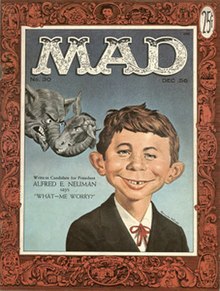
Alfred E. Neuman is the fictitious mascot and cover boy of Mad, an
American humor magazine. The face had drifted through U.S.
pictography for decades before being claimed by Mad editor Harvey
Kurtzman, and later named by the magazine's second editor Al
Feldstein. He appeared occasionally in the early seasons of MADtv
during sketches and interstitials and briefly appeared in the
animated TV series Mad.
Since
his debut in Mad, Neuman's likeness has appeared on the cover of all
but a handful of the magazine's 500 issues, distinguished by jug
ears, a missing front tooth, and one eye lower than the other. His
face is rarely seen in profile; he has virtually always been shown in
front view, directly from behind, or in silhouette. Harvey Kurtzman
first spotted the image on a postcard pinned to the office bulletin
board of Ballantine Books editor Bernard Shir-Cliff. "It was a
face that didn't have a care in the world, except mischief,"
recalled Kurtzman. Shir-Cliff was later a contributor to various
magazines created by Kurtzman...
When
Al Feldstein took over as Mad's editor in 1956, he seized upon the
face: I decided that I wanted to have this visual logo as the image
of Mad, the same way that corporations had the Jolly Green Giant and
the dog barking at the gramophone for RCA. This kid was the perfect
example of what I wanted. So I put an ad in the New York Times that
said, "National magazine wants portrait artist for special
project". In walked this little old guy in his sixties named
Norman Mingo, and he said, "What national magazine is this?"
I said “Mad,” and he said, "Goodbye." I told him to
wait, and I dragged out all these examples and postcards of this
idiot kid, and I said, "I want a definitive portrait of this
kid. I don't want him to look like an idiot — I want him to be
loveable and have an intelligence behind his eyes. But I want him to
have this devil-may-care attitude, someone who can maintain a sense
of humor while the world is collapsing around him." I adapted
and used that portrait, and that was the beginning.
hm... szerinted
mi lehet még lejjebb, mint az újságíróskodás? ha már
haladósnak hiszed magad, próbáld meg lefordítani, hátha megy a
dőlt betűs segítség felhasználásával...
Wikipedia: James Allen "Jim"
Hightower (born January 11, 1943) is an American syndicated
columnist, progressive political activist, and author who
served from 1983 to 1991 as the elected commissioner of the Texas
Department of Agriculture...
...In
recent years, Hightower has advocated for industrial hemp as a
sustainable agricultural crop. Hightower talked about American
farmers being unable to grow hemp due to the current policy of
prohibition saying, "You can buy these hemp products, but –
here comes the goofiness – our farmers are not allowed to grow the
hemp! Instead, it comes from Canada, China, and elsewhere." He
goes on to explain, "Our nation is the world's biggest consumer
of hemp products (from rope to shampoo, building materials to food),
yet the mad masters of our insane "drug war" have lumped
hemp and marijuana together as "Schedule 1 controlled
substances" – making our Land of the Free the world's only
industrialized country that bans farmers from growing this benign,
profitable, job-creating, and environmentally-beneficial, plant."...
...The
"Doug Jones Average," a concept created by Jim Hightower,
is the proposal that in order to check the true health of the
American economy, it is less useful to look at the Dow Jones
Industrial Average than it is to check up on how Doug Jones down the
street is doing. If Doug Jones is on welfare, cannot feed his family,
is blowing his savings, and is three weeks behind on his bills, the
Doug Jones average is "down." If Doug just got a raise, can
pay his bills and Doug and his family are looking into owning a nice
but not too expensive house, the Doug Jones average is "up."
Wikipedia: The United States Disciplinary Barracks on Alcatraz was
acquired by the United States Department of Justice on October 12,
1933, and the island became a federal prison in August 1934. Alcatraz
was designed to hold prisoners who continuously caused trouble at
other federal prisons. At 9:40 am in the morning of August 11, 1934,
the first batch of 137 prisoners arrived at Alcatraz, arriving by
railroad from the United States Penitentiary in Leavenworth, Kansas
at Santa Venetia, California, before being escorted to Alcatraz,
handcuffed in high security coaches and guarded by some 60 special
FBI agents, U.S. Marshals and railway security officials. Most of the
prisoners were notorious bank robbers and murderers. The prison
initially had a staff of 155, including the first warden James A.
Johnston and associate warden J. E. Shuttleworth, both considered to
be "iron men". The staff were highly trained in security,
but not rehabilitation.
During the 29 years it was in use, the jail held some of the most
notorious criminals in American history, such as Al Capone, Robert
Franklin Stroud (the Birdman of Alcatraz), George "Machine Gun"
Kelly, Bumpy Johnson, Rafael Cancel Miranda (a member of the Puerto
Rican Nationalist Party who attacked theUnited States Capitol
building in 1954), Mickey Cohen, Arthur R. "Doc" Barker,
James "Whitey" Bulger, and Alvin "Creepy" Karpis
(who served more time at Alcatraz than any other inmate). It also
provided housing for the Bureau of Prisons staff and their families.
During its 29
years of operation, the penitentiary claimed that no prisoner
successfully escaped. A total of 36 prisoners made 14 escape
attempts, two men trying twice; 23 were caught alive, six were shot
and killed during their escape, two drowned, and five are listed as
"missing and presumed drowned". The most violent occurred
on May 2, 1946, when a failed escape attempt by six prisoners led to
the Battle of Alcatraz.
Harold
Dwight Lasswell, (born February 13, 1902, Donnellson, Illinois, U.S.
— died December 18, 1978, New York, New York) influential political
scientist known for seminal studies of power relations and of
personality and politics and for other major contributions to
contemporary behavioral political science. He authored more than 30
books and 250 scholarly articles on diverse subjects, including
international relations, psychoanalysis, and legal education...
...Lasswell viewed political
science as the study of changes in the distribution of value patterns
in society, and, because distribution depends on power, the focal
point of his analysis was power dynamics. He defined values as
desired goals and power as the ability to participate in decisions,
and he conceived political power as the ability to produce intended
effects on other people. In Politics: Who Gets What, When, How (1936)
— a work whose title later served as the standard lay definition of
politics — he viewed the elite as the primary holders of power, but
in Power and Society: A Framework for Political Inquiry (1950),
written with Abraham Kaplan, the discussion was broadened to include
a general framework for political inquiry that examined key analytic
categories such as person, personality, group, and culture...
...His
works on political psychology include Psychopathology and Politics
(1930), which seeks the means of channeling the desire for domination
to healthy ends; World Politics and Personal Insecurity (1935); and
Power and Personality (1948), which deals with the problem of power
seekers who sublimate their personal frustrations in power. In these
and later works, Lasswell moved toward a moralistic posture, calling
for the social and biological sciences to reorient themselves toward
a science of social policy that would serve the democratic will for
justice. Other features of political science that can be traced to
Lasswell include systems theory, functional and role analysis, and
content analysis...
Wikipedia:
Thomas Jefferson (April 13 [O.S. April 2] 1743 – July 4, 1826) was
an American Founding Father who was principal author of the
Declaration of Independence (1776). He was elected the second Vice
President of the United States (1797–1801), serving under John
Adams and in 1800 was elected third President (1801–09). Jefferson
was a proponent of democracy, republicanism, and individual rights,
which motivated American colonists to break from Great Britain and
form a new nation. He produced formative documents and decisions at
both the state and national level...
...Jefferson
was the primary author of the Declaration of Independence. At age 33
he was one of the youngest delegates to the Second Continental
Congress beginning in 1775 at the outbreak of the American
Revolutionary War where a formal declaration of independence from
Britain was overwhelmingly favored. Jefferson chose his words for the
Declaration in June 1775 shortly after the war had begun where the
idea of Independence from Britain had long since become popular among
the colonies. He was also inspired by the Enlightenment ideals of the
sanctity of the individual as well as the writings of Locke and
Montesquieu...
...The declaration was
introduced on Friday, June 28, and congress began debate over its
contents on Monday, July 1. resulting in the omission of a fourth of
the text, including a passage critical of King George III and the
slave trade. While Jefferson resented the changes, he did not speak
publicly about the revisions. On July 4, 1776, the Congress ratified
the Declaration, and delegates signed it on August 2 and in doing so
were committing an act of treason against the Crown. Jefferson's
preamble is regarded as an enduring statement of human rights, and
the phrase "all men are created equal" has been called "one
of the best-known sentences in the English language" containing
"the most potent and consequential words in American history"...
Wikipedia:
Herbert Arthur "Herb" Shriner (May 29, 1918 – April 23,
1970) was an American humorist, radio personality andtelevision host.
Shriner was known for his homespun monologues, usually about his home
state of Indiana. He was frequently compared to humorist Will
Rogers...
...Shriner
was born Herbert Arthur Schriner in Toledo, Ohio, the son of Edith
(née Rockwell) and Peter Schriner. He moved to Fort Wayne as a small
child, when his mother left his father. Shriner learned to play the
harmonica as a grade school student. He formed a quintet when he was
in high school; expanded to an octet, it made frequent local
appearances. Shriner then performed on his own. When his lip gave out
one night, he filled time by telling homespun stories. His deadpan
comedy routines became more popular than his music, and soon he was
entertaining audiences with stories about a fictional Hoosier
hometown...
...Shriner
and his wife, Eileen “Pixie” McDermott, moved with their children
to Florida, returning each summer to Angola, Indiana. Shriner
invested in real estate and collected vintage automobiles. In 1970,
he and his wife were killed in Delray Beach, Florida, in one of those
cars, a Studebaker Avanti, when the brakes failed. Some of his
collection can be seen in the Auburn Cord Duesenberg Automobile
Museum in Auburn, Indiana.
Shriner's
children are a daughter, Indy (named after Indianapolis, Indiana),
and twin sons, actor, comedian and director Wil Shriner (named for
Will Rogers) andsoap opera actor Kin Shriner (named for Frank
McKinney 'Kin" Hubbard, an early 20th-century Southern Indiana
folk humorist).
On
August 22, 1893, Dorothy Parker was born to J. Henry and Elizabeth
Rothschild, at their summer home in West End, New Jersey. Growing up
on Manhattan’s Upper West Side, her childhood was an unhappy one.
Both her mother and step-mother died when she was young; her uncle,
Martin Rothschild, went down on the Titanic in 1912; and her father
died the following year. Young Dorothy attended a Catholic grammar
school, then a finishing school in Morristown, NJ. Her formal
education abruptly ended when she was 14.
In
1914, Dorothy sold her first poem to Vanity Fair. At age 22, she took
an editorial job at Vogue. She continued to write poems for
newspapers and magazines, and in 1917 she joined Vanity Fair, taking
over for P.G. Wodehouse as drama critic. That same year she married a
stockbroker, Edwin P. Parker. But the marriage was tempestuous, and
the couple divorced in 1928.
In
1919, Parker became a founding member of the Algonquin Round Table,
an informal gathering of writers who lunched at the Algonquin Hotel.
The “Vicious Circle” included Robert Benchley, Harpo Marx, George
S Kaufman, and Edna Ferber, and was known for its scathing wit and
intellectual commentary. In 1922, Parker published her first short
story, “Such a Pretty Little Picture," for Smart Set.
When
the New Yorker debuted in 1925, Parker was listed on the editorial
board. Over the years, she contributed poetry, fiction and book
reviews as the “Constant Reader.”
Parker’s
first collection of poetry, Enough Rope, was published in 1926, and
was a bestseller. Her two subsequent collections were Sunset Gun in
1928 andDeath and Taxes in 1931. Her collected fiction came out in
1930 as Laments for the Living.
During
the 1920s, Parker traveled to Europe several times. She befriended
Ernest Hemingway, F. Scott Fitzgerald, socialites Gerald and Sarah
Murphy, and contributed articles to the New Yorker and Life. While
her work was successful and she was well-regarded for her wit and
conversational abilities, she suffered from depression and alcoholism
and attempted suicide.
In
1929, she won the O. Henry Award for her autobiographical short story
“Big Blonde.” She produced short fiction in the early 1930s, and
also began writing drama reviews for the New Yorker. In 1934, Parker
married actor-writer Alan Campbell in New Mexico; the couple
relocated to Los Angeles and became a highly paid screenwriting team.
They labored for MGM and Paramount on mostly forgettable features,
the highlight being an Academy Award nomination for A Star Is Born in
1937. They divorced in 1947, and remarried in 1950.
Parker,
who became a socialist in 1927 when she became involved in the Sacco
and Vanzetti trial, was called before the House on Un-American
Activities in 1955. She pleaded the Fifth Amendment.
Parker
was inducted into the American Academy of Arts and Letters in 1959
and was a visiting professor at California State College in Los
Angeles in 1963. That same year, her husband died of an overdose. On
June 6, 1967, Parker was found dead of a heart attack in a New York
City hotel at age 73. A firm believer in civil rights, she bequeathed
her literary estate to Dr. Martin Luther King, Jr. Upon his
assassination some months later, the estate was turned over to the
NAACP.
Wikipedia:
Woody Allen is an American film director, screenwriter, actor,
author, jazz musician, comedian and playwright. He contributed to
many films as either actor, director, writer or sometimes both. Allen
wrote four plays for the stage, and written sketches for the Broadway
revue From A to Z, and the Broadway productions Don't Drink the Water
(1966) and Play It Again, Sam (1969).
His
first film was the 1965 comedy What's New Pussycat?, which featured
him as both writer and performer. His directorial debut was the 1966
film What's Up, Tiger Lily?, in which a dramatic Japanese spy movie
was re-dubbed in English with completely new, comic dialog. He
continued to write, direct, and star in comedic slapstick films, such
as Bananas (1971) andSleeper (1973), before he found widespread
critical acclaim for his romantic comedies Annie Hall (1977) and
Manhattan (1979); he won Academy Awards for Best Director and Best
Original Screenplay for the former.
Allen
is influenced by European art cinema and ventured into more dramatic
territory, with Interiors (1978) and Another Woman(1988) being prime
examples of this transition. Despite this, he continued to direct
several comedies, and although Match Point(2005), Vicky Cristina
Barcelona (2008), Midnight in Paris (2011) and Blue Jasmine (2013)
were well-received by critics, many of his recent efforts have
received mixed to negative reviews.
In
addition to works of fiction, Allen appeared as himself in many
documentaries and other works of non-fiction, including Stanley
Kubrick: A Life in Pictures, Wild Man Blues and The Concert for New
York City. He has also been the subject of and appeared in three
documentaries about himself, including To Woody Allen, From Europe
with Love in 1980, Woody Allen: A Life in Film in 2001 and the 2011
PBS American Masters documentary, Woody Allen: a Documentary
(directed by Robert B. Weide). He also wrote for and contributed to a
number of television series early in his career, including The
Tonight Show as guest host.
According
to Box Office Mojo, Allen's films have grossed a total of more than
$575 million, with an average of $14 million per film (domestic gross
figures as a director.) Currently, all of the films he directed for
American International Pictures, United Artists and Orion Pictures
between 1965 and 1992 are owned by Metro-Goldwyn-Mayer, which
acquired all the studios in separate transactions. The films he
directed by ABC Pictures are now propierty of American Broadcasting
Company, who in turn licensed their home video rights to MGM.
Comedian,
actor, singer and writer Groucho Marx was born Julius Henry Marx on
October 2, 1890, in New York City. Groucho Marx spent nearly seven
decades making people laugh with his snappy one-liners and sharp wit.
He once described his comedy as "the type of humor that made
people laugh at themselves."
While
he originally aspired to be a doctor, Marx started his career as a
singer. One of his earliest efforts proved to be disastrous, however.
As part of the Le May Trio, Marx got stuck in Colorado for a while
after another group member took off with his pay. He had to work at a
grocery store to earn enough money to make it back to New York.
Marx's
father Samuel never had much success as a tailor, and the family
struggled financially. His mother Minnie hoped that she might find
prosperity through her five children. She became the quintessential
"stage mother," guiding her children's theatrical acts and
even performing herself. The act eventually featured Groucho and his
brothers Leonard, Adolph and Milton...
...The
Marx Brothers had a career breakthrough in 1914 while performing in
Texas. During a show, some of the audience left to go see a runaway
mule. When they returned, the Marx Brothers put aside their usual
routines to make fun of the audience. Groucho's quick-witted quips
won over the crowd. The switch to comedy proved to be their ticket to
success.
By
the 1920s, the Marx Brothers had become a hugely popular theatrical
act. Groucho had developed some of his trademarks by this time. He
often wore a long coat, a painted-on mustache, thick glasses and held
on to a cigar on stage. In addition to just liking cigars, Marx
explained that they proved useful, too. He said that "if you
forget a line, all you have to do is stick the cigar in your mouth
and puff on it until you think of what you've forgotten."...
Wikipedia:
Joseph Heller (May 1, 1923 – December 12, 1999) was an American
satirical novelist, short story writer, and playwright. The title of
one of his works, Catch-22, entered the English lexicon to refer to a
vicious circle wherein an absurd, no-win choice, particularly in
situations in which the desired outcome of the choice is an
impossibility, and regardless of choice, a same negative outcome is a
certainty. Although he is remembered primarily for Catch-22, his
other works center on the lives of various members of the middle
class and remain examples of modern satire...
...Heller was born on May 1,
1923 in Coney Island in Brooklyn, New York, the son of poor Jewish
parents, Lena and Isaac Donald Heller, from Russia. Even as a child,
he loved to write; as a teenager, he wrote a story about the Russian
invasion of Finland and sent it to the New York Daily News, which
rejected it. After graduating from Abraham Lincoln High School in
1941, Heller spent the next year working as a blacksmith's
apprentice, a messenger boy, and a filing clerk. In 1942, at age 19,
he joined the U.S. Army Air Corps. Two years later he was sent to the
Italian Front, where he flew 60 combat missions as aB-25 bombardier.
His unit was the 488th Bombardment Squadron, 340th Bomb Group, 12th
Air Force. Heller later remembered the war as "fun in the
beginning ... You got the feeling that there was something glorious
about it." On his return home he "felt like a hero ...
People think it quite remarkable that I was in combat in an airplane
and I flew sixty missions even though I tell them that the missions
were largely milk runs" ("Milk runs" were combat
missions, but mostly uneventful due to a lack of intense opposition
from enemy anti-aircraft artillery or fighters)...
a
stoop ige – „lecsap vmire” jelentésén kívüli –
egyéb jelentései még jópofábbak:
[intransitive] stoop (down):
to bend your body forwards and downwards She stooped down to pick
up the child. The doorway was so low that he had to stoop. He tends
to stoop because he’s so tall.
[intransitive] to stand or
walk with your head and shoulders bent forwards He tends to stoop
because he's so tall.
stoop
to something: to drop your moral standards to do something bad or
unpleasant You surely don't think I'd stoop to that!
stoop
to doing something: I didn't think he'd stoop to cheating.
Idioms
stoop so low (as to do
something) (formal): to drop your moral standards far enough to do
something bad or unpleasant She
was unwilling to believe anyone would stoop so low as to steal a ring
from a dead woman's finger.
Wikipedia: Stephen Butler
Leacock (30 December 1869 – 28 March 1944) was a Canadian teacher,
political scientist, writer, and humourist. Between the years 1910
and 1925, he was the most widely read English-speaking author in the
world. He is known for his light humour along with criticisms of
people's follies. The Stephen Leacock Memorial Medal for Humour was
named in his honour.
Wikipedia:
The United States Constitution is the supreme law of
the United States of America. The Constitution, originally
comprising seven articles, delineates the national frame of
government. Its first three articles entrench the doctrine
of the separation of powers, whereby the federal
government is divided into three branches: the legislative,
consisting of the bicameral Congress; the executive,
consisting of the President; and the judicial, consisting
of the Supreme Courtand other federal courts.
Articles Four, Five and Six entrench
concepts of federalism, describing the rights and
responsibilities of state governments and of the states in
relationship to the federal government. Article Sevenestablishes
the procedure subsequently used by the thirteen States to ratify it.
Since the Constitution came
into force in 1789, it has been amended twenty-seven
times. In general, the first ten amendments, known collectively as
the Bill of Rights, offer specific protections of individual
liberty and justice and place restrictions on the powers of
government. The majority of the seventeen later amendments expand
individual civil rights protections. Others address issues related to
federal authority or modify government processes and procedures.
Amendments to the United States Constitution, unlike ones made to
many constitutions world-wide, are appended to the end of the
document. At seven articles and twenty-seven amendments, it is the
shortest written constitution in force. All five pages of the
original U.S. Constitution are written on parchment.
The
Constitution is interpreted, supplemented, and implemented by a large
body of constitutional law. The Constitution of the United
States is the first constitution of its kind, adopted by the people’s
representatives for an expansive nation; and it has influenced the
constitutions of other nations.
Douglas
Adams was born in Cambridge in March 1952, educated at Brentwood
School, Essex and St John's College, Cambridge where, in 1974 he
gained a BA (and later an MA) in English literature.
He
was creator of all the various manifestations of The
Hitchhiker’s Guide to the Galaxywhich started life as a BBC Radio 4
series. Since its first airing in March 1978 it has been transformed
into a series of best-selling novels, a TV series, a record album, a
computer game and several stage adaptations.
The
Hitchhiker's Guide to the Galaxy's phenomenal success sent the book
straight to Number One in the UK Bestseller List and in 1984 Douglas
Adams became the youngest author to be awarded a Golden Pan. He won a
further two (a rare feat), and was nominated - though not selected -
for the first Best of Young British Novelists awards.
He
followed this success with The Restaurant at the End of the
Universe (1980); Life, The Universe and Everything (1982); So
Long and Thanks for all the Fish (1984); and Mostly
Harmless (1992). The first two books in the Hitchhiker series
were adapted into a 6 part television series, which was an immediate
success when first aired in 1982. Other publications include
Dirk Gently's Holistic Detective Agency (1987) and Long
Dark Tea-time of the Soul (1988). In 1984 Douglas teamed up with
John Lloyd and wrote The Meaning of Liff and after a huge
success The Deeper Meaning of Liff followed this in 1990). One of
Douglas’s all-time personal favourites was written in 1990 when he
teamed up with zoologist Mark Carwardine and wrote Last Chance
to See – an account of a world-wide search for rare and
endangered species of animals.
He
sold over 15 million books in the UK, the US and Australia and was
also a best seller in German, Swedish and many other languages.
Douglas
was a founding director of h2g2, formerly The Digital Village, a
digital media and Internet company with which he created the 1998
CD-ROMStarship Titanic, a Codie Award-winning (1999) and
BAFTA-nominated (1998) adventure game.
Douglas
died unexpectedly in May 2001 of a sudden heart attack. He was 49. He
had been living in Santa Barbara, California with his wife and
daughter, and at the time of his death he was working on the
screenplay for a feature film version of Hitchhiker.
Wikipedia:
Edward Frederick Lindley Wood, 1st Earl of Halifax, KG OM GCSI GCMG
GCIE TD PC (16 April 1881 – 23 December 1959), styled Lord Irwin
from 1925 until 1934 and Viscount Halifax from 1934 until 1944, was
one of the most senior British Conservative politicians of the 1930s.
He held several senior ministerial posts during this time, most
notably those of Viceroy of India from 1925 to 1931 and of Foreign
Secretary between 1938 and 1940. He is regarded as one of the
architects of the policy of appeasement prior to the Second World
War. From 1941 to 1946, he served as British Ambassador in
Washington...
...In
November 1937, Halifax went to Germany at the invitation of Hermann
Göring on the pretext of a hunting exhibition (Göring was a
passionate hunter and gave Halifax the nickname Halalifax, after
Halali!, a German hunting call), but Halifax was publicly and
correctly regarded as acting on behalf of the British government to
renew dialogue with the German government. A long and barbed meeting
with Adolf Hitler ensued. On meeting the Führer, Halifax almost
created an incident by nearly handing his coat to him, believing him
to be a footman: "As I looked out of the car window, on eye
level, I saw in the middle of this swept path a pair of black
trousered legs, finishing up in silk socks and pumps. I assumed this
was a footman who had come down to help me out of the car and up the
steps, and was proceeding in leisurely fashion to get myself out of
the car when I heard Von Neurath or somebody throwing a hoarse
whisper at my ear of ‘Der Führer, der Führer’; and it then
dawned upon me that the legs were not the legs of a footman, but of
Hitler". In discussions Halifax ignored Eden's reservations and
indicated clearly to Hitler that German designs on Austria and parts
of Czechoslovakia and Poland were not regarded as illegitimate by the
British, but that only peaceful processes of change would be
acceptable. Writing to Baldwin on the subject of the conversation
between Karl Burckhardt (the League of Nations' Commissioner of
Danzig) and Hitler, Halifax said, "Nationalism and Racialism is
a powerful force but I can't feel that it's either unnatural or
immoral! I cannot myself doubt that these fellows are genuine haters
of Communism etc.! And I daresay if we were in their position we
might feel the same!"
The
following year Eden resigned, exasperated by the continued
interference of the Prime Minister in foreign affairs and his
increasingly determined policy of appeasement (particularly of Benito
Mussolini, whom Eden regarded as an untrustworthy gangster). For
Halifax, as for Chamberlain and the Chiefs of Staff, every effort had
to be made to prevent an alignment of the three great threats to
peace and the British Empire: Italy, Germany and Japan. Halifax
replaced Eden asForeign Secretary in February 1938.
Wikipedia:
Mary Jane "Mae" West (August 17, 1893 –
November 22, 1980) was an American actress, singer, playwright,
screenwriter, and sex symbol whose entertainment career
spanned seven decades.
Known
for her bawdy double entendres, West made a name for herself
in vaudeville and on the stage in New York City before
moving to Hollywood to become a comedian, actress, and writer in the
motion picture industry. For her contributions to American cinema,
the American Film Institute named West 15th among
the greatest female stars of classic American cinema.
One
of the more controversial movie stars of her day, West encountered
many problems, including censorship. When her cinematic career
ended, she continued to perform in Las Vegas, in the United
Kingdom, and on radio and television, and to record rock and roll
albums. Asked about the various efforts to impede her career, West
replied: "I believe in censorship. I made a fortune out of it."
Wikipedia: Samuel
Goldwyn (born Szmuel Gelbfisz (Yiddish: שמואל
געלבפֿיש);
August 17, 1879 – January 31, 1974), also known as Samuel
Goldfish, was a Jewish Polish American film producer.
He was most well known for being the founding contributor and
executive of several motion picture studios in Hollywood. His
awards include the 1973 Golden Globe Cecil B. DeMille Award,
the Irving G. Thalberg Memorial Award in 1947, and the Jean
Hersholt Humanitarian Awardin 1958...
...Samuel
Goldwyn was also known for malapropisms, paradoxes, and other
speech errors called 'Goldwynisms' ("A humorous statement or
phrase resulting from the use of incongruous or contradictory words,
situations, idioms, etc.") being frequently quoted. For example,
he was reported to have said, "I don't think anybody should
write his autobiography until after he's dead." and "Include
me out."...
...Some
famous Goldwyn quotations are misattributions... ...Upon being told
that a book he had purchased for filming, The Well of
Loneliness, couldn't be filmed because it was about lesbians, he
reportedly replied: "That's all right, we'll make them
Hungarians." The same story was told about the 1934 rights
to The Children's Hour with the response "That's okay;
we'll turn them into Armenians."...
Wikipedia:
...During both terms in office, Brown commuted 23 death sentences,
signing the first commutation on his second day in office. One of his
more notable commutations was the death sentence of Erwin
"Machine-Gun" Walker, whose execution in the gas chamber
for first-degree murder had been postponed because of an
attempted suicide some hours before it was scheduled to
take place. After Walker recovered, his execution was postponed while
he was being restored to mental competency. After Walker was declared
sane in 1961, Brown commuted Walker's death sentence to life without
the possibility of parole. Walker was later paroled after the
California Supreme Court held that Governor Brown could not legally
deny a prisoner the right to parole in a death-sentence commutation.
Another prisoner whose death sentence was commuted by Brown committed
at least one murder after being paroled.
While Governor, Brown's attitude
toward the death penalty was often ambivalent, if not arbitrary. An
ardent supporter of gun control, he was more inclined to let
convicts go to the gas chamber if they had killed with guns than with
other weapons. He later admitted that he had denied clemency in one
death penalty case principally because the legislator who represented
the district in which the murder occurred held a swing vote on
farmworker legislation supported by Brown, and had told Brown that
his district "would go up in smoke" if the governor
commuted the man's sentence.
In contrast, Governor Brown
approved 36 executions, including the highly controversial cases
of Caryl Chessman in 1960 and Elizabeth Duncan; she
was the last female put to death before a national moratorium was
instituted. Though he had supported the death penalty while serving
as district attorney, as Attorney General, and when first elected
Governor, he later became an opponent of it.
During
the Chessman case, Brown proposed that the death penalty be
abolished, but the proposal failed. His Republican successor, Ronald
Reagan, was a firm death penalty supporter and oversaw the last
execution in California in 1967, prior to the US Supreme Court ruling
that it was unconstitutional in Furman v. Georgia (1972).