Angolszász idézetek fordítással, Off Course nyelvtan videókkal és mondatgyűjteménnyel ______________________www.facebook.com/offcourseangol_____________________
...How many Hungarians live and work abroad? According to the last official statistics of the Central Statistical Office (KSH), their number in 2012 was 230,000. By 2013 KSH and SEEMIG (Managing Migration and Its Effects in South-East Europe) upped this number to close to 420,000. We still have no figures for 2015, but given recent trends the number of Hungarian emigrants at the moment is estimated to be somewhere between 500,000 and 800,000. In six years the rate of emigration has increased sixfold...
...Where did these 500,000-800,000 people go? Earlier most of them went to the United Kingdom, Germany, and Austria, but Hungarians are starting to discover equally inviting destinations: Sweden, Denmark, Ireland, and the Netherlands.
...BBC published a short article, “Hungary: Government seeks to lure young expats back home.” In it they report on a “counter poster” that was an answer to the government’s billboard, “If you come to Hungary you cannot take away Hungarians’ jobs.” It read: “You may safely come to Hungary, we are already working in England.”
WikiLeaks is an international, non-profit, journalistic organisation, that publishes secret information, news leaks, and classified media from anonymous sources. Its website, initiated in 2006 in Iceland by the organization Sunshine Press, claimed a database of more than 1.2 million documents within a year of its launch...
The logo of WikiLeaks, an hourglass with oneglobe leaking to the second
...2016: On 4 July 2016, WikiLeaks tweeted a link to a trove of emails sent or received by then-US Secretary of State Hillary Clinton published on their website. The leak, which contained 1258 emails sent from Clinton's personal mail server, were selected in terms of their relevance to the Iraq War and were apparently timed to precede the release of the UK government's Iraq Inquiry report.
On 19 July 2016, WikiLeaks released 294,548 emails from Turkey's ruling party, Justice and Development party (AKP). According to WikiLeaks, the material, which they claim to be the first batch from the "AKP Emails", was obtained a week before the attempted coup in the country and "is not connected, in any way, to the elements behind the attempted coup, or to a rival political party or state". After WikiLeaks announced that they would release the emails, the organization stayed for over 24 hours under a "sustained attack". Following the leak, the Turkish government ordered the site to be blocked nationwide.
On 22 July 2016, WikiLeaks released approximately 20,000 emails sent from or received by Democratic National Committee personnel. Some of the emails contained personal information of donors, including home addresses and Social Security numbers. Other emails appeared to present ways to undercut Bernie Sanders and showed apparent favoritism towards Clinton...
ha
te is elmúltál már legalább hatvan, akkor tudhatod, mi az
akármilyen élet titka, vagyis hogy mi illik a mondat végére.
aztán... bölcs lehetsz ugyan, de az angol fordításod sajna nem
fog hibátlanra sikerülni (még a dőlt betűs segítséggel sem),
hm.
Wikipedia: Johnny Weissmuller (born Johann Peter Weißmüller; June 2, 1904 – January 20, 1984) was an Austro-Hungarian born American competition swimmer and actor best known for playing Tarzan in films of the 1930s and 1940s and for having one of the best competitive swimming records of the 20th century. Weissmuller was one of the world's fastest swimmers in the 1920s, winning five Olympic gold medals for swimming and one bronze medal for water polo. He won fifty-two U.S. National Championships, set more than fifty world records (spread over both freestyle and backstroke), and was purportedly undefeated in official competition for the entirety of his competitive career. After retiring from competitions, he became the sixth actor to portray Edgar Rice Burroughs's ape man, Tarzan, a role he played in twelve motion pictures. Dozens of other actors have also played Tarzan, but Weissmuller is by far the best known. His character's distinctive Tarzan yell is still often used in films...
1940
...In all, Weissmuller won five Olympic gold medals and one bronze medal, fifty-two United States national championships, and set sixty-seven world records. He was the first man to swim the 100-meter freestyle under one minute and the 440-yard freestyle under five minutes. He never lost a race and retired with an unbeaten amateur record. In 1950, he was selected by the Associated Press as the greatest swimmer of the first half of the 20th Century...
1970
...According to the book by Weissmuller's son Tarzan, My Father, while playing golf in Cuba in 1958 during the Cuban Revolution, Weissmuller's golf cart was suddenly surrounded by rebel soldiers. Weissmuller was unable to communicate who he was until he got out of the cart and attempted the trademark Tarzan yell. The soldiers then recognized him and shouted '"Es Tarzan! Es Tarzan de la Jungla!" Johnny and his companions were not only not kidnapped, but the guerillas gave him an escort to his hotel...
elég
bölcs vagy-e ahhoz, hogy kitaláld, hol?... a fordításoddal úgy
találhatod el az eredetit, ha felhasználod a dőlt betűsöket.
(vigyázz, három helyen is hibázhatsz!)
Wikipedia: Sir Ahmad Salman Rushdie, (Kt.) FRSL (/sælˈmɑːn ˈrʊʃdi/; Kashmiri: अहमद सलमान रुशदी(Devanagari), احمد سلمان رشدی (Nastaʿlīq); born 19 June 1947 is a British Indian novelist and essayist. His second novel, Midnight's Children(1981), won the Booker Prize in 1981. Much of his fiction is set on the Indian subcontinent. He combines magical realism with historical fiction; his work is concerned with the many connections, disruptions, and migrations betweenEastern and Western civilizations.
(photo: www.flickr.com)
His fourth novel, The Satanic Verses (1988), was the subject of a major controversy, provoking protests from Muslims in several countries. Death threats were made against him, including a fatwā calling for his assassination issued byAyatollah Ruhollah Khomeini, the Supreme Leader of Iran, on 14 February 1989. The British government put Rushdie under police protection.
In 1983 Rushdie was elected a fellow of the Royal Society of Literature, the UK's senior literary organisation. He was appointed Commandeur de l'Ordre des Arts et des Lettres of France in January 1999. In June 2007, Queen Elizabeth II knighted him for his services to literature. In 2008, The Times ranked him thirteenth on its list of the 50 greatest British writers since 1945.
Since 2000, Rushdie has lived in the United States, where he has worked at Emory University. He was elected to theAmerican Academy of Arts and Letters. In 2012, he published Joseph Anton: A Memoir, an account of his life in the wake of the controversy over The Satanic Verses.
rendhagyó darab (rendet vagy rendetlenséget hagyott?)... ha nem érted
a hiányt, hagyd csak. ha igen, akkor jöhet az egyedi, személyes
fordításod, magadnak. (az induláshoz kapsz dőlt betűs ötletet.)
Mi, ugye, most nem találunk szavakat. Nekünk a szó vigaszunk és a támaszunk, a szó a mindenünk és a semmiségünk, anyánk, apánk, a testvérünk, a feleségünk, a gyerekek. Ami történt, ahhoz a szó nem elég, ezt most nem bírja el. A szóba Isten akárhogyan, haragvón vagy részrehajlón, mohón vagy fáradtan, de belefér. Az ember halála meg sehogyan sem. Pedig hogy így fog történni, vagyis, pontosabban, hogy ez fog történni, eléggé tudtuk, akként kellett értékelnünk a híreket, hogy kimondtak egy ítéletet, és aztán maradt a remény, a tétova, szorongó egyezkedés. Az ország egy jelentékeny darabja veszett el vele. Mert olyan volt ő, mint egy különleges intézmény. A mi saját bejáratú intézményünk. A szabadság, a szellem, a pontosság, az elegancia és a mérték intézménye. A szavainkból most oly magától értetődően lehetne káromlás vagy nyüszítés, lehetne csöndes, cizellált gyász, elveszett motyogás, mi mégis arra gondolunk, hogy nem akarjuk sem ezt, sem azt, valahogy semmilyen formát nem találunk adekvátnak, semmilyen megfogalmazást nem tekintünk alkalmasnak. Vitánk a halállal nem termékeny. Nem lesz benne semmi jó, semmi megértés, nem lesz benne semmi hozadék. Nem, nem fogadjuk el, viszont ami elveszett, az elveszett. Ám tőle – is – tanultuk, hogy minden van. Ez is van. Egy ilyen helyzet. Egy ember, tegyük oda a Kapucinus-ház bejárata elé, és mondjuk el, mint egy kivételes úrnál, hogy nem voltál senki és semmi, mert ekképpen kell átmenni oda. S ha úgy is ment át, hát a hagyatékát fölbecsülni sem tudjuk. Tanultuk azt, hogyan beszél. Tanultuk azt, hogyan gondolkodik. Tanultuk azt, hogyan értelmez. Tanultuk azt, hogyan érez. Tanultuk, hogyan csodálkozik, jé, tényleg, de okos vagy. Halljuk, ahogy mondja. Hűvösségét, könnyed arisztokratizmusát ámultuk. Olyan közel voltunk hozzá, hogy kicsit mindig távol maradtunk. Nem értettük, hogyan csinálja. S ha a posztmodern elleni egyik legnagyobb vád az, hogy relativizál, hogy összemos jót és rosszat, csúfot és szépet, akkor ő, éppen ő ennek az ellenkezőjét tette, a folyamatosan fölülírt, megkommentált, megkérdőjelezett, elidézett szövegben mindig ott volt a morál és a tisztánlátás aranyfedezete. Soha nem a történést írta meg, alá vagy fölé fogalmazott. A fogalmazást igazán angyali értelemben gondoljuk. Jóllehet csak egy író volt, konkrétan kevesen tettek annyit, hogy ez az ország szabadabb, élhetőbb legyen. Minden mozdulata esemény volt. Te jó ég, hogy miféle tartással lépdelt át ezen az utolsó esztendőn is!
Wikipedia:The
term "democracy" first appeared in ancient Greek political
and philosophical thought in the city-state of Athens during
classical antiquity. Led by Cleisthenes, Athenians established what
is generally held as the first democracy in 508–507 BC. Cleisthenes
is referred to as "the father of Athenian democracy."
Athenian democracy took the form
of a direct democracy, and it had two distinguishing features: the
random selection of ordinary citizens to fill the few existing
government administrative and judicial offices, and a legislative
assembly consisting of all Athenian citizens. All eligible citizens
were allowed to speak and vote in the assembly, which set the laws of
the city state. However, Athenian citizenship excluded women, slaves,
foreigners (μέτοικοι / métoikoi), non-landowners, and males
under 20 years old.
Cleisthenes,
"father ofAthenian democracy", modern bust
...Aristotle: But
one factor of liberty is to govern and be governed in turn; for the
popular principle of justice is to have equality according to number,
not worth, ... And one is for a man to live as he likes; for they say
that this is the function of liberty, inasmuch as to live not as one
likes is the life of a man that is a slave...
...Several
freedom indices are used to measure democracy:
--
Freedom in the World published each year since 1972 by the U.S.-based
Freedom House ranks countries by political rights and civil liberties
that are derived in large measure from the Universal Declaration of
Human Rights. Countries are assessed as free, partly free, or unfree.
--
Worldwide Press Freedom Index is published each year since 2002
(except that 2011 was combined with 2012) by France-based Reporters
Without Borders. Countries are assessed as having a good situation, a
satisfactory situation, noticeable problems, a difficult situation,
or a very serious situation.
--
Freedom of the Press published each year since 1980 by Freedom
House...
szerintem itt és most azonnal
ki fogod találni, hogy kik ellen :) a fordítás meg tényleg
egyszerű – az egész azon múlik, tudod-e hogyan használd a dőlt
betűs szót...
Wikipedia:
A vote is a formal expression of an individual's choice in voting,
for or against some motion (for example, a proposed resolution), for
or against some ballot question, for a certain candidate, a selection
of candidates, or a political party. A secret ballot has come to be
the practice to prevent voters from being intimidated and to protect
their political privacy.
In
a democracy, a government is chosen by voting in an election: a way
for an electorate to elect, i.e. choose, among several candidates for
rule. In a representative democracy voting is the method by which the
electorate appoints its representatives in its government. In a
direct democracy, voting is the method by which the electorate
directly make decisions, turn bills into laws, etc.
Voting
usually takes place at a polling station; it is voluntary in some
countries, compulsory in others, such as Australia...
...Modern
political science has questioned whether average citizens have
sufficient political information to cast meaningful votes. A series
of studies coming out of the University of Michigan in the 1950s and
1960s argued that voters lack a basic understanding of current
issues, the liberal–conservative ideological dimension, and the
relative ideological dilemma.
Studies
from other institutions have suggested that the physical appearance
of candidates is a criterion upon which voters base their decision.
In
Switzerland, without need to register, every citizen receives at home
the ballot papers and information brochure for each voting (and can
send it back by post). Switzerland has adirect democracy system and
votes are organised about four times a year.
...Most
of the time, when the citizens of a country are invited to vote, it
is for an election. However, people can also vote in referendums and
initiatives. Since the end of the eighteenth century, more than five
hundred national referendums (including initiatives) were organised
in the world; among them, more than three hundred were held in
Switzerland. Australia ranked second with dozens of referendums.
Wikipedia:
Margaret Mead (December 16, 1901 – November 15, 1978) was an
American cultural anthropologist who featured frequently as an author
and speaker in the mass media during the 1960s and 1970s...
...Mead
was a respected and often controversial academic who popularized the
insights of anthropology in modern American and Western culture. Her
reports detailing the attitudes towards sex in South Pacific and
Southeast Asian traditional cultures influenced the 1960s sexual
revolution. She was a proponent of broadening sexual mores within a
context of traditional Western religious life...
Margaret Mead in 1948.
...Another
influential book by Mead was Sex and Temperament in Three Primitive
Societies. This became a major cornerstone of the feminist movement,
since it claimed that females are dominant in the Tchambuli (now
spelled Chambri) Lake region of the Sepik basin of Papua New Guinea
(in the western Pacific) without causing any special problems. The
lack of male dominance may have been the result of the Australian
administration's outlawing of warfare. According to contemporary
research, males are dominant throughout Melanesia (although some
believe that female witches have special powers) . Others have argued
that there is still much cultural variation throughout Melanesia, and
especially in the large island of New Guinea. Moreover,
anthropologists often overlook the significance of networks of
political influence among females. The formal male-dominated
institutions typical of some areas of high population density were
not, for example, present in the same way in Oksapmin, West Sepik
Province, a more sparsely populated area. Cultural patterns there
were different from, say, Mt. Hagen. They were closer to those
described by Mead.
Mead
stated that the Arapesh people, also in the Sepik, were pacifists,
although she noted that they do on occasion engage in warfare. Her
observations about the sharing of garden plots among the Arapesh, the
egalitarian emphasis in child rearing, and her documentation of
predominantly peaceful relations among relatives are very different
from the "big man" displays of dominance that were
documented in more stratified New Guinea cultures – e.g. by Andrew
Strathern. They are a different cultural pattern...
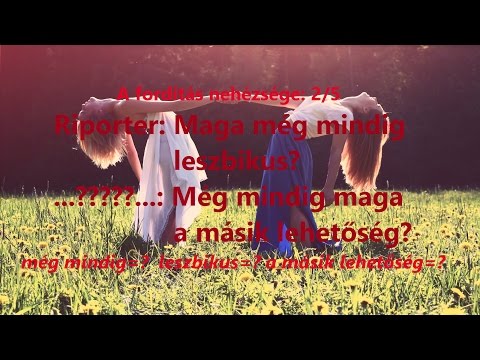
Kitalálod-e,
melyik sportoló szólt így vissza a riporternek? aztán fordítsd
le gyorsan, mert pofonegyszerű – valószínűleg a „leszbikus”
fordításánál fogsz beleszaladni egy pofonba. a „másik
lehetőség”-nél meg egy másikba :)
Wikipedia: ...The most extensive early
study of female homosexuality was provided by the Institute for Sex
Research, who published an in-depth report of the sexual experiences
of American women in 1953. More than 8,000 women were interviewed by
Alfred Kinsey and the staff of the Institute for Sex Research in a
book titled Sexual Behavior in the Human Female, popularly known as
part of the Kinsey Report. The Kinsey Report's dispassionate
discussion of homosexuality as a form of human sexual behavior was
revolutionary. Up to this study, only physicians and psychiatrists
studied sexual behavior, and almost always the results were
interpreted with a moral view.
Kinsey and
his staff reported that 28% of women had been aroused by another
female, and 19% had a sexual contact with another female. Of women
who had sexual contact with another female, half to two-thirds of
them had orgasmed. Single women had the highest prevalence of
homosexual activity, followed by women who were widowed, divorced, or
separated. The lowest occurrence of sexual activity was among married
women; those with previous homosexual experience reported they got
married to stop homosexual activity...
...Lesbians
in the U.S. are estimated to be about 2.6% of the population,
according to a National Opinion Research Center survey of sexually
active adults who had had same-sex experiences within the past year,
completed in 2000. A survey of same-sex couples in the United States
showed that between 2000 and 2005, the number of people claiming to
be in same-sex relationships increased by 30%—five times the rate
of population growth in the U.S. The study attributed the jump to
people being more comfortable self-identifying as homosexual to the
federal government.
A lesbian couple married in San
Francisco in 2004
The
government of the United Kingdom does not ask citizens to define
their sexuality. However, a survey by the UK Office for National
Statistics (ONS) in 2010 found that 1.5% of Britons identified
themselves as gay or bisexual, and the ONS suggests that this is in
line with other surveys showing the number between 0.3% and 3%.
Estimates of lesbians are sometimes not differentiated in studies of
same-sex households, such as those performed by the U.S. census, and
estimates of total gay, lesbian, or bisexual population by the UK
government. However, polls in Australia have recorded a range of
self-identified lesbian or bisexual women from 1.3% to 2.2% of the
total population.
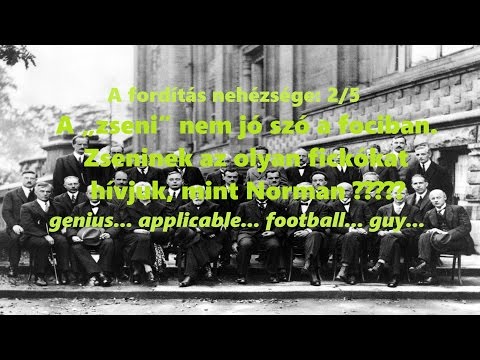
ezt
egy hátvédből lett sportkommentátor mondta – tudod-e kapásból,
kire gondolt?... a 2/5 nehézségű fordítást egy apróság miatt a
3-4 szintű mesterek is elbukhatják... (használd a dőlt betűs
segítséget!)
Albert
Einstein has been the subject of or inspiration for many works of
popular culture.
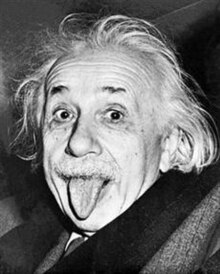
On Einstein's 72nd birthday on
March 14, 1951, UPI photographer Arthur Sasse was trying to persuade
him to smile for the camera, but having smiled for photographers many
times that day, Einstein stuck out his tongue instead. This
photograph became one of the most popular ever taken of Einstein,
often used in merchandise depicting him in a lighthearted sense.
Einstein enjoyed this photo and requested UPI to give him nine copies
for personal use, one of which he signed for a reporter. On June 19,
2009, the original signed photograph was sold at auction for $74,324,
a record for an Einstein picture.
Einstein
is a favorite model for depictions of mad scientists and
absent-minded professors; his expressive face and distinctive
hairstyles have been widely copied and exaggerated. Time magazine's
Frederic Golden wrote that Einstein was "a cartoonist's dream
come true."
"Einstein"
has become a word used to describe someone extremely intelligent; the
name is also applied sarcastically to someone who states the obvious
or displays a lack of intelligence or insight ("Way to go,
Einstein!")...
...His
birthday, March 14, is also Pi Day, so called because 3/14
corresponds to 3.14, the first three digits of the number Pi. The
town of Princeton, New Jersey, where Einstein lived for more than 20
years, celebrates March 14 every year as "Princeton Pi Day and
Einstein Birthday Party."...
...There is a persistent popular
belief that Einstein was left-handed, but there is no evidence that
he was, and the belief has been called a myth. Einstein wrote with
his right hand, and authoritative sources state flatly that he was
right-handed. An autopsy on Einstein's brain showed a symmetry
between the two hemispheres, rather than a left-sided dominance as is
typical of most right-handed people or a right-sided dominance as
found in most left-handed people...
...Einstein
in video games:
Einstein is an integral character in the Command &
Conquer: Red Alert series, being responsible in Red Alert for
altering the course of history using a time traveling device he
created to remove Adolf Hitler from existence in an attempt to
prevent the horrors of World War II, inadvertently leading to Soviet
Union's rise to power and conflict with Europe. He continues to be
featured in the altered timeline in Red Alert and Red Alert 2
developing time travel technology for use by the Allies, and his
fictional murder at the hands of the Soviets, also involving a time
machine, is a central plot point of Red Alert 3.
In
Mega Man, released in 1987, Dr. Wily's design is inspired by Albert
Einstein, and was initially conceived to appear as a tall, thin
scientist with a mustache, glasses, balding hair, and lab coat.
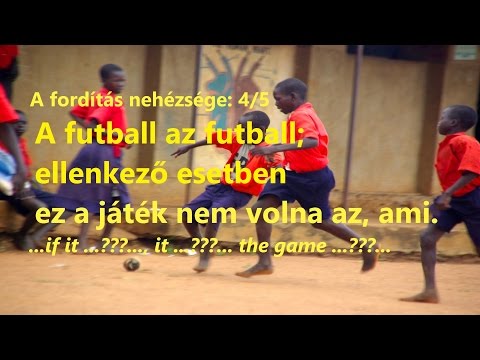
Wikipedia:
The 2016 UEFA European Championship, commonly referred to as UEFA
Euro 2016, is the 15th UEFA European Championship, the quadrennial
international men's football championship of Europe organised by
UEFA. It is currently being held in France from 10 June to 10 July
2016. Spain are the two-time defending champions, having won the2008
and 2012 editions...
...Romania, Turkey, Austria and
Switzerland all returned after missing out in 2012, with the
Austrians qualifying for just their second final Euro tournament,
after having co-hosted Euro 2008. Returning to the final tournament
after long absences were Belgium for the first time since co-hosting
Euro 2000, and Hungary for the first time in 44 years, having last
appeared at Euro 1972, and 30 years since appearing in a major
tournament, their previous one being the 1986 FIFA World Cup...
...A total of €301 million
will be distributed to the 24 teams contesting in the tournament, a
growth from the €196 million payment in the preceding event. Each
team will be rewarded €8 million, with further rewards depending on
their performances. The champions of the competition will be awarded
€8 million in addition to any prize money earned in earlier rounds
– the biggest prize attainable is €27 million (for winning all
group bouts and the final)...
...The
official mascot of the tournament, Super Victor, was unveiled on 18
November 2014. He is a child superhero in the kit of the France
national football team, with a red cape at the back, to echo the
colours of the Flag of France. The cape, boots and ball are claimed
to be the child's superpowers...
...The
competition's official opening song is "This One's for You"
by David Guetta featuring Zara Larsson, and the official closing song
is "Free Your Mind" by Maya Lavelle. It was reported that
David Guetta sought one million fans to add their voices to the
official anthem via a website.
hm...
ha kitalálod melyik szó hiányzik, megtudod, hogy pont ez az Off
Course Angol véleménye is a britek kilépéséről... (a fordítással
meg vigyázz, mert a „miféle” megoldásánál akkor is
elbakizhatod, ha haladó vagy!...)
Good
morning everyone, the country has just taken part in a giant
democratic exercise, perhaps the biggest in our history.
Over
33 million people from England, Scotland, Wales, Northern Ireland and
Gibraltar have all had their say.
We
should be proud of the fact that in these islands we trust the people
for these big decisions.
We
not only have a parliamentary democracy, but on questions about the
arrangements for how we've governed there are times when it is right
to ask the people themselves and that is what we have done.
The
British people have voted to leave the European Union and their will
must be respected.
I
want to thank everyone who took part in the campaign on my side of
the argument, including all those who put aside party differences to
speak in what they believe was the national interest and let me
congratulate all those who took part in the Leave campaign for the
spirited and passionate case that they made.
The
will of the British people is an instruction that must be delivered.
It
was not a decision that was taken lightly, not least because so many
things were said by so many different organisations about the
significance of this decision.
So
there can be no doubt about the result.
Across
the world people have been watching the choice that Britain has made.
I
would reassure those markets and investors that Britain's economy is
fundamentally strong and I would also reassure Britons living in
European countries and European citizens living here there will be no
immediate changes in your circumstances.
There
will be no initial change in the way our people can travel, in the
way our goods can move or the way our services can be sold.
We
must now prepare for a negotiation with the European Union.
This
will need to involve the full engagement of the Scottish, Welsh and
Northern Ireland governments to ensure that the interests of all
parts of our United Kingdom are protected and advanced.
But
above all this will require strong, determined and committed
leadership.
I'm
very proud and very honoured to have been Prime Minister of this
country for six years.
I
believe we've made great steps, with more people in work than ever
before in our history, with reforms to welfare and education,
increasing people's life chances, building a bigger and stronger
society, keeping our promises to the poorest people in the world and
enabling those who love each other to get married whatever their
sexuality, but above all restoring Britain's economic strength.
And
I'm grateful to everyone who's helped to make that happen.
I
have also always believed that we have to confront big decisions, not
duck them.
That
is why we delivered the first coalition government in 70 years, to
bring our economy back from the brink.
It's
why we delivered a fair, legal and decisive referendum in Scotland.
And
it's why I made the pledge to renegotiate Britain's position in the
European Union and to hold the referendum on our membership and have
carried those things out.
I
fought this campaign in the only way I know how, which is to say
directly and passionately what I think and feel - head, heart and
soul.
I
held nothing back, I was absolutely clear about my belief that
Britain is stronger, safer and better off inside the European Union
and I made clear the referendum was about this and this alone - not
the future of any single politician including myself.
But
the British people have made a very clear decision to take a
different path and as such I think the country requires fresh
leadership to take it in this direction.
I
will do everything I can as Prime Minister to steady the ship over
the coming weeks and months but I do not think it would be right for
me to try to be the captain that steers our country to its next
destination.
This
is not a decision I've taken lightly but I do believe it's in the
national interest to have a period of stability and then the new
leadership required.
There
is no need for a precise timetable today but in my view we should aim
to have a new prime minister in place by the start of the
Conservative Party conference in October.
Delivering
stability will be important and I will continue in post as Prime
Minister with my Cabinet for the next three months.
The
Cabinet will meet on Monday, the Governor of the Bank of England is
making a statement about the steps that the Bank and the Treasury are
taking to reassure financial markets.
We
will also continue taking forward the important legislation that we
set before Parliament in the Queen's Speech.
And
I have spoken to Her Majesty the Queen this morning to advise her of
the steps that I am taking.
A
negotiation with the European Union will need to begin under a new
prime minister and I think it's right that this new prime minister
takes the decision about when to trigger Article 50 and start the
formal and legal process of leaving the EU.
I
will attend the European Council next week to explain the decision
the British people have taken and my own decision.
The
British people have made a choice, that not only needs to be
respected but those on the losing side of the argument - myself
included - should help to make it work.
Britain
is a special country - we have so many great advantages - a
parliamentary democracy where we resolve great issues about our
future through peaceful debate, a great trading nation with our
science and arts, our engineering and our creativity, respected the
world over.
And
while we are not perfect I do believe we can be a model for the
multi-racial, multi-faith democracy, that people can come and make a
contribution and rise to the very highest that their talent allows.
Although
leaving Europe was not the path I recommended, I am the first to
praise our incredible strengths.
I
said before that Britain can survive outside the European Union and
indeed that we could find a way.
Now
the decision has been made to leave, we need to find the best way and
I will do everything I can to help.
I
love this country and I feel honoured to have served it and I will do
everything I can in future to help this great country succeed.
Wikipedia:
Richard Marvin "Dick" Butkus (born December 9, 1942) is a
former American football linebacker who played for the Chicago Bears
of the National Football League (NFL). He was drafted in 1965 and is
also widely regarded as one of the best and most durable linebackers
of all time. Butkus played college football for the Fighting Illini
at the University of Illinois. He became a member of the Pro Football
Hall of Fame in 1979. He played nine seasons in the NFL for the
Chicago Bears. Billed at 6 ft 3 in (1.91 m), 245 lb (111 kg), he was
considered one of the most feared and intimidating linebackers of his
time, being named the most feared tackler of all time by NFL.com in
2009...
...Butkus
was selected to eight Pro Bowls and was all-league six times. In his
rookie season, Butkus led the Bears in tackles, interceptions, forced
fumbles, and fumble recoveries, and regularly led the team in these
categories throughout his career. Butkus recovered 27 fumbles in his
career, an NFL record at the time of his retirement. He was one of
the most feared players of his era and even appeared on the cover of
Sports Illustrated in 1970 with the caption "The Most Feared Man
in the Game." He had one of his most productive seasons in 1970
with 132 tackles, 84 assists, 3 interceptions and 2 fumble
recoveries. He was forced to retire after multiple knee injuries in
1973...
...One
of Butkus' greatest strengths was his ability to rip the ball from a
ball carrier's hands. Although back then the statistic was not kept,
it has been noted that Butkus would certainly be one of the all-time
leaders in the forced fumbles category.
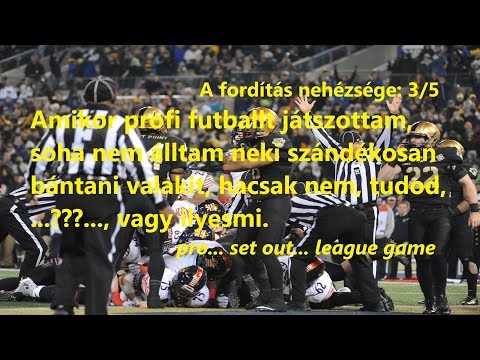
melyik
hova illik a dőlt betűsök közül? (vigyázz, az egyik sehova...) a
babakönnyű fordítás pedig szinte kezdőknek való, önvizsgálatra
:) egyébként: használd a have igét!
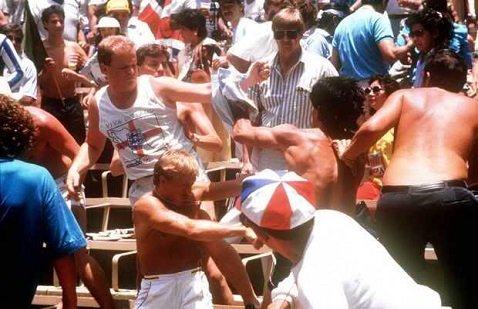
The
number of football-related arrests in England and Wales fell last
season, according to Home Office figures. In the 2008/09 campaign,
police made a total of 3,752 arrests at domestic and international
football matches, a fall of 2% on the season before. On average
there was 1.18 arrests per game, and the Home Office say 354 people
were arrested for violence. In all, 956 football banning orders were
issued during the 2008/09 season, with 37 million people attending
games. In the Premier League, champions Manchester United had the
most fans arrested - 185 in total. Second was relegated Newcastle
United with 144 arrests and third was Everton with 139. Fulham had
the fewest fans arrested with just 13. Supporters of League One
Leeds United topped the banning order list, with 162, ahead of
Championship side Cardiff City (124) and League One outfit Millwall
(110). Fans were generally well-behaved abroad - more than 105,000
fans travelled to 49 games in European club competitions last season
but only 30 were arrested.
Source:
BBC Sport - 22nd December 2009
Over
five million journeys a year are undertaken on the rail network by
football fans alone.
In 2008/09 there were just 51 serious
football related incidents, down from 63 the previous year. However,
there were another 538 reported incidents of anti-social behaviour
which impacted on other passengers and rail staff, up from 337 the
year before. In the 2008/09 season BTP officers made 838 arrests,
the highest to date, up from 601 the previous year.
Wikipedia:
Garth Anthony Crooks, OBE (born 10 March 1958) is an English former
professional footballer. He played for Stoke City, Tottenham Hotspur,
Manchester United, West Bromwich Albion and Charlton Athletic.
Throughout his career he was an active member of the Professional
Footballers' Association and was elected the first black chairman of
the union. He currently works for the BBC as a television pundit...
...In
1988, Crooks became the first black chairman of the Professional
Footballers' Association but gave up the role after retiring in 1990.
He first worked in the media as a match analyst at the 1982 and 1990
World Cups and later worked as Match of the Day's reporter at the
England camp at Euro 2000 and the 2002 World Cup. In the late 1990s,
Crooks became presenter of the political television show Despatch
Box. In 1999 he was awarded an OBE in the Queen's Birthday Honoursfor
his services to football punditry, specifically citing his ability to
bring passion to football. He currently appears regularly on Final
Score as a pundit and on rare occasions still appears on Match of the
Day as a replacement for regular pundits Alan Shearer and Mark
Lawrenson. He is occasionally seen interviewing players for BBC
television after league football matches. He also names his team of
the week (Premier League) each week on the BBC website.
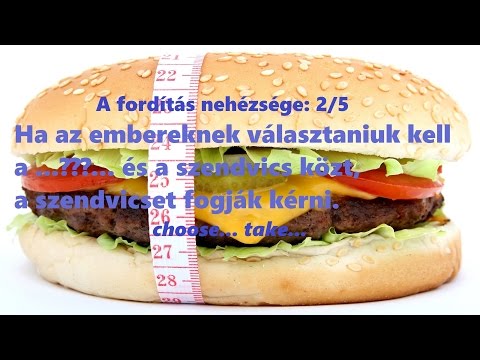
nyilván te is a szendvicset
választanád a ??? helyett?... a fordítás könnyűnek tűnik –
ha megnézed, mihez jár nyelvtani segítség, tán nem is hibázol...
Wikipedia:
John Boyd Orr, 1st Baron Boyd-Orr CH, DSO, MC, FRS (23 September 1880
– 25 June 1971), known as Sir John Boyd Orr from 1935 to 1949, was
a Scottish teacher, doctor, biologist and politician who received the
Nobel Peace Prize for his scientific research into nutrition and his
work as the first Director-General of the United Nations Food and
Agriculture Organization (FAO). He was the co-founder and the first
President (1960–1971) of the World Academy of Art and Science
(WAAS)...
...As
an undergraduate in Glasgow, he explored the interior of the city,
usually at weekends. He was shocked by what he found in the
poverty-stricken slums and tenements, which then made up a large part
of the city. Rickets was obvious among the children, malnutrition (in
some cases, associated with drunkenness) was shown by many of the
adults, and many of the aged were destitute. In his first teaching
job after graduating M.A. in 1902, he was posted to a school in the
slums. His first class was overcrowded, and the children ill-fed or
actually hungry, inadequately clothed, visibly lousy and physically
wretched. He resigned after a few days, realising that he could not
teach children in such a condition, and that there was nothing he
could do to relieve their misery...
...On leaving the university, he
took a position as a ship's surgeon on a ship trading between
Scotland and West Africa, choosing this job because it offered the
possibility of paying off his bank overdraft faster than any other.
He resigned after four months, when he had repaid the debt. He then
tried general practice, working as a locum in the practice of his
family doctor in Saltcoats, and was offered a partnership there.
Realising that a career in medicine was not for him, he instead
accepted the offer of a two-year Carnegie research scholarship, to
work in E.P. Cathcart's laboratory. The work he began there covered
malnutrition, protein andcreatine metabolism, the effect of water
intake on nitrogenous metabolism in humans, and the energy
expenditure of military recruits in training...
...Orr,
by now Rector of the University of Glasgow, was elected as an
independent Member of Parliament (MP) for the Combined Scottish
Universities in a by-election in April 1945, and kept his seat at the
general election shortly after. He resigned in 1946...
...After
the Second World War, Boyd Orr resigned from the Rowett Institute,
and took several posts, most notably at the FAO, where his
comprehensive plans for improving food production and its equitable
distribution failed to get the support of Britain and the US. He then
resigned from the FAO and became director of a number of companies
and proved a canny investor in the stock market, making a
considerable personal fortune. When he received the Nobel Peace Prize
in 1949, he donated the entire financial award to organizations
devoted to world peace and a united world government...
...In
1960 Boyd Orr was elected the first president of the World Academy of
Art and Science, which was set up by eminent scientists of the day
concerned about the potential misuse of scientific discoveries, most
especially nuclear weapons.
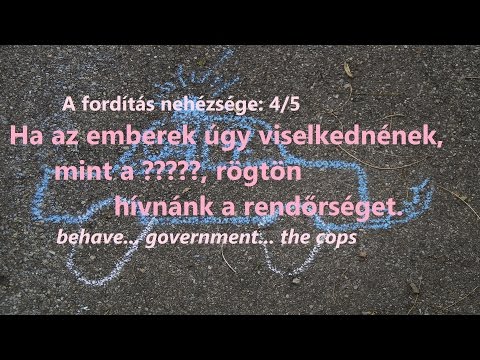
ha
az Off Course Angolon edződtél, akkor tudni fogod, mi hiányzik :)
...és akkor a feltételes mód sem fog gondot okozni –
viszont vannak egyéb nehézségek...
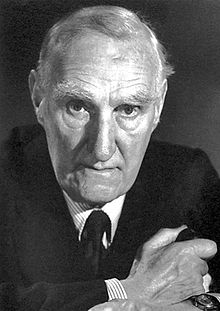
Wikipedia:
Kelvin R. Throop (also 'Kelvin R. Throop III' or 'Kelvin Throop III')
is a fictional character and collective pseudonym created by R. A. J.
Phillips in a story which appeared in Analog Science Fiction and
Science Fact magazine in July 1964. With the encouragement of editor
John W. Campbell, Throop subsequently figured in additional stories
by other authors. The archetypal Throop story finds him within a
large bureaucracy which, solely by his acid-penned memos, he causes
to self-destruct, whereupon he disappears until the next story. In
mid-December 1984, Analog published a special Kelvin Throop humor
edition. Numerous humorous epigrams attributed to Throop were
published in Analog over a period of decades...
...Analog
Science Fiction and Fact is an American science fiction magazine. As
of 2015, it is the longest running continuously published magazine of
that genre, the June 2015 issue being number 1,000.
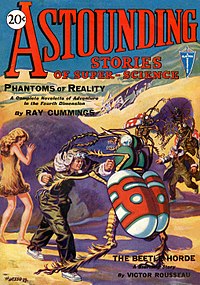
The
first issue of Astounding Stories, January 1930
Initially
published in 1930 in the United States as Astounding Stories as a
pulp magazine, it has undergone several name changes, primarily
toAstounding Science-Fiction in 1938, and Analog Science Fact &
Fiction in 1960. In November 1992, its logo changed to use the term
"Fiction and Fact" rather than "Fact & Fiction".
It is in the library of the International Space Station. Spanning
three incarnations since 1930, this is perhaps the most influential
magazine in the history of the genre. It remains a fixture of the
genre today...
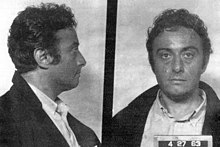
Wikipedia:
Leonard Alfred Schneider (October 13, 1925 – August 3, 1966),
better known by his stage name Lenny Bruce, was an American stand-up
comedian, social critic, satirist, and screenwriter. He was renowned
for his open, free-style and critical form of comedy which integrated
satire, politics, religion, sex, and vulgarity. His 1964 conviction
in an obscenitytrial was followed by a posthumous pardon, the first
in New York State history, by then-Governor George Pataki in 2003. He
paved the way for future outspoken counterculture-era comedians, and
his trial for obscenity is seen as a landmark for freedom of speech
in the United States...
...On
October 4, 1961, Bruce was arrested for obscenity at the Jazz
Workshop in San Francisco; he had used the wordcocksucker and riffed
that "to is a preposition, come is a verb", that the sexual
context of come is so common that it bears no weight, and that if
someone hearing it becomes upset, he "probably can't come".
Although the jury acquitted him, other law enforcement agencies began
monitoring his appearances, resulting in frequent arrests under
charges of obscenity...
...Bruce
was arrested again in 1961... ...The specification this time was that
the comedian had used the word schmuck, an insulting Yiddish term
that is an obscene term for penis...
...On
December 5, 1962, Bruce was arrested at the legendary Gate of Horn
folk club in Chicago...
...In
April 1964, he appeared twice at the Cafe Au Go Go in Greenwich
Village with undercover police detectives in the audience. He was
arrested along with the club owners, Howard and Elly Solomon, who
were arrested for allowing an obscene performance to take place. On
both occasions, he was arrested after leaving the stage, the
complaints again pertaining to his use of various obscenities...
...On
December 23, 2003, 37 years after his death, New York Governor George
Pataki granted Bruce a posthumous pardon for his obscenity
conviction.
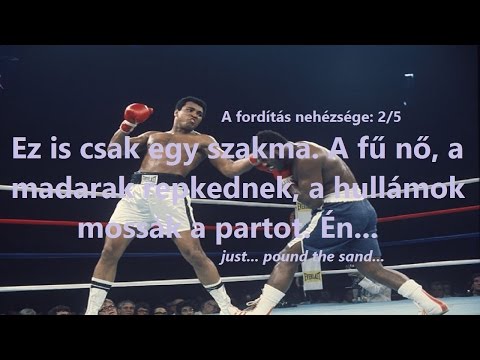
the last bit of a strong Ali
week: a bokszoló (Muhammad Ali) hitvallása – be tudod fejezni? a
fordítás meg sima ügy – bár egy hibát szinte biztosan elkövetsz...
Arguably boxing's most celebrated
athlete, heavyweight champion Muhammad Ali was also known for his
public stance against the Vietnam War and his longtime battle with
Parkinson's disease...
...Born Cassius Clay in Louisville,
Kentucky, in 1942, Muhammad Ali became an Olympic gold medalist in
1960 and the world heavyweight boxing champion in 1964. Following his
suspension for refusing military service, Ali reclaimed the
heavyweight title two more times during the 1970s, winning famed
bouts against Joe Frazier and George Foreman along the way. Diagnosed
with Parkinson's disease in 1984, Ali devoted much of his time to
philanthropy, earning the Presidential Medal of Freedom in 2005. He
died on June 3, 2016, in Phoenix, Arizona...
...In his retirement, Ali devoted much
of his time to philanthropy. He announced that he had Parkinson's
disease in 1984, a degenerative neurological condition, and was
involved in raising funds for the Muhammad Ali Parkinson Center in
Phoenix, Arizona. Over the years, Ali also supported the Special
Olympics and the Make-A-Wish Foundation, among other organizations.
In 1996, he lit the Olympic cauldron at the Summer Olympic Games in
Atlanta, an emotional moment in sports history...
...Ali traveled to numerous countries,
including Mexico and Morocco, to help out those in need. In 1998, he
was chosen to be a United Nations Messenger of Peace because of his
work in developing nations.
nem fogod kitalálni, hogyan
vágott vissza poénosan a légikisasszony a viccesen nagyképű
Alinak! a fordításban csak a felszólítást és „sem”-et kell
jól csinálnod, ráadásul itt végre tök laza lehetsz, például
kétszer is duplán tagadhatsz :)
Wikipedia:
...Vietnam War and resistance to the draft
Ali registered for conscription
in the United States military on his 18th birthday and was listed as
1-A in 1962. In 1964, he was reclassified as Class 1-Y (fit for
service only in times of national emergency) after two mental tests
found his IQ was 78 (16th percentile), well below the armed force's
30th-percentile threshold. (He was quoted as saying, "I said I
was the greatest, not the smartest!") By early 1966, the army
lowered its standards to permit soldiers above the 15th percentile
and Ali was again classified as 1-A. This classification meant he was
now eligible for the draft and induction into the United States Army
during a time when the U.S. was involved in the Vietnam War.
When notified of this status,
Ali declared that he would refuse to serve in the army and publicly
considered himself a conscientious objector. Ali stated: "War is
against the teachings of the Qur'an. I'm not trying to dodge the
draft. We are not supposed to take part in no wars unless declared by
Allah or The Messenger. We don't take part in Christian wars or wars
of any unbelievers." He famously stated: "Man, I ain't got
no quarrel with them Viet Cong." Ali elaborated: "Why
should they ask me to put on a uniform and go ten thousand miles from
home and drop bombs and bullets on brown people in Vietnam while
so-called Negro people in Louisville are treated like dogs and denied
simple human rights?"
Appearing
for his scheduled induction into the U.S. Armed Forces on April 28,
1967, in Houston, Ali refused three times to step forward at the call
of his name. An officer warned him he was committing a felony
punishable by five years in prison and a fine of $10,000. Once more,
Ali refused to budge when his name was called. As a result, he was
arrested. On the same day the New York State Athletic Commission
suspended his boxing license and stripped him of his title. Other
boxing commissions followed suit. Ali would not be able to obtain a
license to box in any state for over three years.
At
the trial on June 20, 1967, after only 21 minutes of deliberation,
the jury found Ali guilty. After a Court of Appeals upheld the
conviction, the case went to the U.S. Supreme Court.
In
the years between the Appellate Court decision and the Supreme Court
verdict, Ali remained free. As public opinion began turning against
the war and the Civil Rights Movement continued to gather momentum,
Ali became a popular speaker at colleges and universities across the
country, rare if not unprecedented for a boxer. At Howard University,
for example, he gave his popular "Black Is Best" speech to
4,000 cheering students and community intellectuals, after he was
invited to speak by sociology professor Nathan Hare on behalf of the
Black Power Committee, a student protest group.
On
June 28, 1971, the Supreme Court of the United States in Clay v.
United States overturned Ali's conviction by a unanimous 8–0
decision (Justice Thurgood Marshall recused himself, as he had been
the U.S. Solicitor General at the time of Ali's conviction). The
decision was not based on, nor did it address, the merits of Ali's
claims per se; rather, the Court held that since the Appeal Board
gave no reason for the denial of a conscientious objector exemption
to Ali, and that it was therefore impossible to determine which of
the three basic tests for conscientious objector status offered in
the Justice Department's brief that the Appeals Board relied on,
Ali's conviction must be reversed.
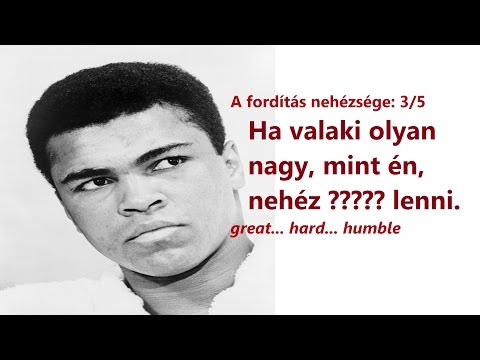
szerény
képzelőerőddel is ki fogod találni, melyik szó hiányzik (adok
dőlt betűs segítséget). a fordításban viszont szinte biztosan
elkövetsz egy hibát, még ha haladósnak is érzed magad...
Muhammad
Ali, the silver-tongued boxer and civil rights champion who famously
proclaimed himself "The Greatest" and then spent a lifetime
living up to the billing, is dead.
Ali
died Friday at a Phoenix-area hospital, where he had spent the past
few days being treated for respiratory complications, a family
spokesman confirmed to NBC News. He was 74.
"After
a 32-year battle with Parkinson's disease, Muhammad Ali has passed
away at the age of 74. The three-time World Heavyweight Champion
boxer died this evening," Bob Gunnell, a family spokesman, told
NBC News...
...In
recent years, Ali's health began to suffer dramatically. There was a
death scare in 2013, and last year he was rushed to the hospital
after being found unresponsive. He recovered and returned to his new
home in Arizona.
In
his final years, Ali was barely able to speak. Asked to share his
personal philosophy with NPR in 2009, Ali let his wife read his
essay: "I never thought of the possibility of failing, only of
the fame and glory I was going to get when I won," Ali wrote. "I
could see it. I could almost feel it. When I proclaimed that I was
the greatest of all time, I believed in myself, and I still do."
kitalálod-e, miért nincs
jelentősége –
Samuel Johnson szerint? (szerinted igaza
van?!) a fordítással komolyan tesztelheted magad, vajon tényleg
haladó vagy-e (vagy csak beképzelt)...
Wikipedia:
Samuel Johnson (18 September 1709 [O.S. 7 September] – 13 December
1784), often referred to as Dr Johnson, was an English writer who
made lasting contributions to English literature as a poet, essayist,
moralist, literary critic, biographer, editor and lexicographer.
Johnson was a devout Anglican and committed Tory, and has been
described as "arguably the most distinguished man of letters in
English history"...
In 1746, a group of publishers
approached Johnson with an idea about creating an authoritative
dictionary of the English language. A contract with William Strahan
and associates, worth 1,500 guineas, was signed on the morning of 18
June 1746. Johnson claimed that he could finish the project in three
years. In comparison, the Académie Française had forty scholars
spending forty years to complete their dictionary, which prompted
Johnson to claim, "This is the proportion. Let me see; forty
times forty is sixteen hundred. As three to sixteen hundred, so is
the proportion of an Englishman to a Frenchman." Although he did
not succeed in completing the work in three years, he did manage to
finish it in eight. Some criticised the dictionary, including Thomas
Babington Macaulay, who described Johnson as "a wretched
etymologist," but according to Bate, the Dictionary "easily
ranks as one of the greatest single achievements of scholarship, and
probably the greatest ever performed by one individual who laboured
under anything like the disadvantages in a comparable length of
time."...
...The Dictionary was finally
published in April 1755, with the title page acknowledging that
Oxford had awarded Johnson a Master of Arts degree in anticipation of
the work. The dictionary as published was a huge book. Its pages were
nearly 18 inches (46 cm) tall, and the book was 20 inches (51 cm)
wide when opened; it contained 42,773 entries, to which only a few
more were added in subsequent editions, and it sold for the
extravagant price of £4 10s, perhaps the rough equivalent of £350
today. An important innovation in English lexicography was to
illustrate the meanings of his words by literary quotation, of which
there were approximately 114,000. The authors most frequently cited
include William Shakespeare, John Milton and John Dryden. It was
years beforeJohnson's Dictionary, as it came to be known, turned a
profit. Authors' royalties were unknown at the time, and Johnson,
once his contract to deliver the book was fulfilled, received no
further money from its sale. Years later, many of its quotations
would be repeated by various editions of the Webster's Dictionary and
the New English Dictionary.


.jpg/220px-Johnny_Weissmuller_(1970).jpg)



.jpg/220px-Margaret_Mead_(1901-1978).jpg)