98. body and soul


 segítség a nyelvtanhoz:
  * to + főnévi igenév_mondatok

On August 22, 1893, Dorothy Parker was born to J. Henry and Elizabeth Rothschild, at their summer home in West End, New Jersey. Growing up on Manhattan’s Upper West Side, her childhood was an unhappy one. Both her mother and step-mother died when she was young; her uncle, Martin Rothschild, went down on the Titanic in 1912; and her father died the following year. Young Dorothy attended a Catholic grammar school, then a finishing school in Morristown, NJ. Her formal education abruptly ended when she was 14.
In 1914, Dorothy sold her first poem to Vanity Fair. At age 22, she took an editorial job at Vogue. She continued to write poems for newspapers and magazines, and in 1917 she joined Vanity Fair, taking over for P.G. Wodehouse as drama critic. That same year she married a stockbroker, Edwin P. Parker. But the marriage was tempestuous, and the couple divorced in 1928.
In 1919, Parker became a founding member of the Algonquin Round Table, an informal gathering of writers who lunched at the Algonquin Hotel. The “Vicious Circle” included Robert Benchley, Harpo Marx, George S Kaufman, and Edna Ferber, and was known for its scathing wit and intellectual commentary. In 1922, Parker published her first short story, “Such a Pretty Little Picture," for Smart Set.
When the New Yorker debuted in 1925, Parker was listed on the editorial board. Over the years, she contributed poetry, fiction and book reviews as the “Constant Reader.”
Parker’s first collection of poetry, Enough Rope, was published in 1926, and was a bestseller. Her two subsequent collections were Sunset Gun in 1928 andDeath and Taxes in 1931. Her collected fiction came out in 1930 as Laments for the Living.
During the 1920s, Parker traveled to Europe several times. She befriended Ernest Hemingway, F. Scott Fitzgerald, socialites Gerald and Sarah Murphy, and contributed articles to the New Yorker and Life. While her work was successful and she was well-regarded for her wit and conversational abilities, she suffered from depression and alcoholism and attempted suicide.
In 1929, she won the O. Henry Award for her autobiographical short story “Big Blonde.” She produced short fiction in the early 1930s, and also began writing drama reviews for the New Yorker. In 1934, Parker married actor-writer Alan Campbell in New Mexico; the couple relocated to Los Angeles and became a highly paid screenwriting team. They labored for MGM and Paramount on mostly forgettable features, the highlight being an Academy Award nomination for A Star Is Born in 1937. They divorced in 1947, and remarried in 1950.
Parker, who became a socialist in 1927 when she became involved in the Sacco and Vanzetti trial, was called before the House on Un-American Activities in 1955. She pleaded the Fifth Amendment.
Parker was inducted into the American Academy of Arts and Letters in 1959 and was a visiting professor at California State College in Los Angeles in 1963. That same year, her husband died of an overdose. On June 6, 1967, Parker was found dead of a heart attack in a New York City hotel at age 73. A firm believer in civil rights, she bequeathed her literary estate to Dr. Martin Luther King, Jr. Upon his assassination some months later, the estate was turned over to the NAACP.
(www.poets.org)
97. fat guy


 segítség a nyelvtanhoz:
  * feltételes mód (videó)
  * feltételes mód_mondatok
  * mindegyik, az összes_mondatok

Wikipedia: Woody Allen is an American film director, screenwriter, actor, author, jazz musician, comedian and playwright. He contributed to many films as either actor, director, writer or sometimes both. Allen wrote four plays for the stage, and written sketches for the Broadway revue From A to Z, and the Broadway productions Don't Drink the Water (1966) and Play It Again, Sam (1969).
His first film was the 1965 comedy What's New Pussycat?, which featured him as both writer and performer. His directorial debut was the 1966 film What's Up, Tiger Lily?, in which a dramatic Japanese spy movie was re-dubbed in English with completely new, comic dialog. He continued to write, direct, and star in comedic slapstick films, such as Bananas (1971) andSleeper (1973), before he found widespread critical acclaim for his romantic comedies Annie Hall (1977) and Manhattan (1979); he won Academy Awards for Best Director and Best Original Screenplay for the former.
Allen is influenced by European art cinema and ventured into more dramatic territory, with Interiors (1978) and Another Woman(1988) being prime examples of this transition. Despite this, he continued to direct several comedies, and although Match Point(2005), Vicky Cristina Barcelona (2008), Midnight in Paris (2011) and Blue Jasmine (2013) were well-received by critics, many of his recent efforts have received mixed to negative reviews.
In addition to works of fiction, Allen appeared as himself in many documentaries and other works of non-fiction, including Stanley Kubrick: A Life in Pictures, Wild Man Blues and The Concert for New York City. He has also been the subject of and appeared in three documentaries about himself, including To Woody Allen, From Europe with Love in 1980, Woody Allen: A Life in Film in 2001 and the 2011 PBS American Masters documentary, Woody Allen: a Documentary (directed by Robert B. Weide). He also wrote for and contributed to a number of television series early in his career, including The Tonight Show as guest host.
According to Box Office Mojo, Allen's films have grossed a total of more than $575 million, with an average of $14 million per film (domestic gross figures as a director.) Currently, all of the films he directed for American International Pictures, United Artists and Orion Pictures between 1965 and 1992 are owned by Metro-Goldwyn-Mayer, which acquired all the studios in separate transactions. The films he directed by ABC Pictures are now propierty of American Broadcasting Company, who in turn licensed their home video rights to MGM.

96. women


 segítség a nyelvtanhoz:
  * igeidők (videó)
  * látja jönni, látja megjönni_mondatok
  * -ing-es alak vagy to+főnévi igenév bizonyos igék után_mondatok

Comedian, actor, singer and writer Groucho Marx was born Julius Henry Marx on October 2, 1890, in New York City. Groucho Marx spent nearly seven decades making people laugh with his snappy one-liners and sharp wit. He once described his comedy as "the type of humor that made people laugh at themselves."
While he originally aspired to be a doctor, Marx started his career as a singer. One of his earliest efforts proved to be disastrous, however. As part of the Le May Trio, Marx got stuck in Colorado for a while after another group member took off with his pay. He had to work at a grocery store to earn enough money to make it back to New York.
Marx's father Samuel never had much success as a tailor, and the family struggled financially. His mother Minnie hoped that she might find prosperity through her five children. She became the quintessential "stage mother," guiding her children's theatrical acts and even performing herself. The act eventually featured Groucho and his brothers Leonard, Adolph and Milton...
...The Marx Brothers had a career breakthrough in 1914 while performing in Texas. During a show, some of the audience left to go see a runaway mule. When they returned, the Marx Brothers put aside their usual routines to make fun of the audience. Groucho's quick-witted quips won over the crowd. The switch to comedy proved to be their ticket to success.
By the 1920s, the Marx Brothers had become a hugely popular theatrical act. Groucho had developed some of his trademarks by this time. He often wore a long coat, a painted-on mustache, thick glasses and held on to a cigar on stage. In addition to just liking cigars, Marx explained that they proved useful, too. He said that "if you forget a line, all you have to do is stick the cigar in your mouth and puff on it until you think of what you've forgotten."...
(www.biography.com)

95. little boy


 Segítség a nyelvtanhoz: 
  * feltételes mód (videó)
  * feltételes mód_mondatok

Wikipedia: Joseph Heller (May 1, 1923 – December 12, 1999) was an American satirical novelist, short story writer, and playwright. The title of one of his works, Catch-22, entered the English lexicon to refer to a vicious circle wherein an absurd, no-win choice, particularly in situations in which the desired outcome of the choice is an impossibility, and regardless of choice, a same negative outcome is a certainty. Although he is remembered primarily for Catch-22, his other works center on the lives of various members of the middle class and remain examples of modern satire...
...Heller was born on May 1, 1923 in Coney Island in Brooklyn, New York, the son of poor Jewish parents, Lena and Isaac Donald Heller, from Russia. Even as a child, he loved to write; as a teenager, he wrote a story about the Russian invasion of Finland and sent it to the New York Daily News, which rejected it. After graduating from Abraham Lincoln High School in 1941, Heller spent the next year working as a blacksmith's apprentice, a messenger boy, and a filing clerk. In 1942, at age 19, he joined the U.S. Army Air Corps. Two years later he was sent to the Italian Front, where he flew 60 combat missions as aB-25 bombardier. His unit was the 488th Bombardment Squadron, 340th Bomb Group, 12th Air Force. Heller later remembered the war as "fun in the beginning ... You got the feeling that there was something glorious about it." On his return home he "felt like a hero ... People think it quite remarkable that I was in combat in an airplane and I flew sixty missions even though I tell them that the missions were largely milk runs" ("Milk runs" were combat missions, but mostly uneventful due to a lack of intense opposition from enemy anti-aircraft artillery or fighters)...

94. stoop


a stoop ige – „lecsap vmire” jelentésén kívüli – egyéb jelentései még jópofábbak:
  1. [intransitive] stoop (down): to bend your body forwards and downwards She stooped down to pick up the child. The doorway was so low that he had to stoop. He tends to stoop because he’s so tall.
  2. [intransitive] to stand or walk with your head and shoulders bent forwards He tends to stoop because he's so tall.
  3. stoop to something: to drop your moral standards to do something bad or unpleasant You surely don't think I'd stoop to that!
  4. stoop to doing something: I didn't think he'd stoop to cheating.
Idioms
stoop so low (as to do something) (formal): to drop your moral standards far enough to do something bad or unpleasant She was unwilling to believe anyone would stoop so low as to steal a ring from a dead woman's finger.
http://www.oxfordlearnersdictionaries.com

93. founding


 Segítség a nyelvtanhoz:
  * feltételes mód (videó)
  * feltételes mód_mondatok

Wikipedia: Stephen Butler Leacock (30 December 1869 – 28 March 1944) was a Canadian teacher, political scientist, writer, and humourist. Between the years 1910 and 1925, he was the most widely read English-speaking author in the world. He is known for his light humour along with criticisms of people's follies. The Stephen Leacock Memorial Medal for Humour was named in his honour.

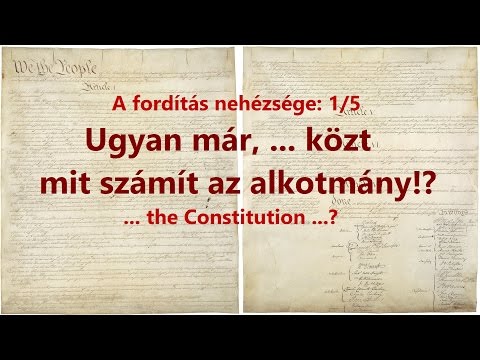
92. Constitution


Segítség a nyelvtanhoz: semmi-de-semmi

Wikipedia: The United States Constitution is the supreme law of the United States of America. The Constitution, originally comprising seven articles, delineates the national frame of government. Its first three articles entrench the doctrine of the separation of powers, whereby the federal government is divided into three branches: the legislative, consisting of the bicameral Congress; the executive, consisting of the President; and the judicial, consisting of the Supreme Courtand other federal courts. Articles Four, Five and Six entrench concepts of federalism, describing the rights and responsibilities of state governments and of the states in relationship to the federal government. Article Sevenestablishes the procedure subsequently used by the thirteen States to ratify it.
Since the Constitution came into force in 1789, it has been amended twenty-seven times. In general, the first ten amendments, known collectively as the Bill of Rights, offer specific protections of individual liberty and justice and place restrictions on the powers of government. The majority of the seventeen later amendments expand individual civil rights protections. Others address issues related to federal authority or modify government processes and procedures. Amendments to the United States Constitution, unlike ones made to many constitutions world-wide, are appended to the end of the document. At seven articles and twenty-seven amendments, it is the shortest written constitution in force. All five pages of the original U.S. Constitution are written on parchment.
The Constitution is interpreted, supplemented, and implemented by a large body of constitutional law. The Constitution of the United States is the first constitution of its kind, adopted by the people’s representatives for an expansive nation; and it has influenced the constitutions of other nations.

91. pretty


 Segítség a nyelvtanhoz:
  * no vagy not_mondatok
  * igeidők (videó)
  * összehasonlítás és fokozás_mondatok

Douglas Adams was born in Cambridge in March 1952, educated at Brentwood School, Essex and St John's College, Cambridge where, in 1974 he gained a BA (and later an MA) in English literature.
He was creator of all the various manifestations of The Hitchhiker’s Guide to the Galaxywhich started life as a BBC Radio 4 series. Since its first airing in March 1978 it has been transformed into a series of best-selling novels, a TV series, a record album, a computer game and several stage adaptations.
The Hitchhiker's Guide to the Galaxy's phenomenal success sent the book straight to Number One in the UK Bestseller List and in 1984 Douglas Adams became the youngest author to be awarded a Golden Pan. He won a further two (a rare feat), and was nominated - though not selected - for the first Best of Young British Novelists awards.
He followed this success with The Restaurant at the End of the Universe (1980); Life, The Universe and Everything (1982); So Long and Thanks for all the Fish (1984); and Mostly Harmless (1992). The first two books in the Hitchhiker series were adapted into a 6 part television series, which was an immediate success when first aired in 1982. Other publications include Dirk Gently's Holistic Detective Agency (1987) and Long Dark Tea-time of the Soul (1988). In 1984 Douglas teamed up with John Lloyd and wrote The Meaning of Liff and after a huge success The Deeper Meaning of Liff followed this in 1990). One of Douglas’s all-time personal favourites was written in 1990 when he teamed up with zoologist Mark Carwardine and wrote Last Chance to See – an account of a world-wide search for rare and endangered species of animals.
He sold over 15 million books in the UK, the US and Australia and was also a best seller in German, Swedish and many other languages.
Douglas was a founding director of h2g2, formerly The Digital Village, a digital media and Internet company with which he created the 1998 CD-ROMStarship Titanic, a Codie Award-winning (1999) and BAFTA-nominated (1998) adventure game.
Douglas died unexpectedly in May 2001 of a sudden heart attack. He was 49. He had been living in Santa Barbara, California with his wife and daughter, and at the time of his death he was working on the screenplay for a feature film version of Hitchhiker.
(www.douglasadams.com)

90. at Oxford


 segítség a nyelvtanhoz:
  * összehasonlítás és fokozás_mondatok
  * feltételes mód (videó)
  * feltételes mód_mondatok
  * időegyeztetés (videó)

Wikipedia: Edward Frederick Lindley Wood, 1st Earl of Halifax, KG OM GCSI GCMG GCIE TD PC (16 April 1881 – 23 December 1959), styled Lord Irwin from 1925 until 1934 and Viscount Halifax from 1934 until 1944, was one of the most senior British Conservative politicians of the 1930s. He held several senior ministerial posts during this time, most notably those of Viceroy of India from 1925 to 1931 and of Foreign Secretary between 1938 and 1940. He is regarded as one of the architects of the policy of appeasement prior to the Second World War. From 1941 to 1946, he served as British Ambassador in Washington...
...In November 1937, Halifax went to Germany at the invitation of Hermann Göring on the pretext of a hunting exhibition (Göring was a passionate hunter and gave Halifax the nickname Halalifax, after Halali!, a German hunting call), but Halifax was publicly and correctly regarded as acting on behalf of the British government to renew dialogue with the German government. A long and barbed meeting with Adolf Hitler ensued. On meeting the Führer, Halifax almost created an incident by nearly handing his coat to him, believing him to be a footman: "As I looked out of the car window, on eye level, I saw in the middle of this swept path a pair of black trousered legs, finishing up in silk socks and pumps. I assumed this was a footman who had come down to help me out of the car and up the steps, and was proceeding in leisurely fashion to get myself out of the car when I heard Von Neurath or somebody throwing a hoarse whisper at my ear of ‘Der Führer, der Führer’; and it then dawned upon me that the legs were not the legs of a footman, but of Hitler". In discussions Halifax ignored Eden's reservations and indicated clearly to Hitler that German designs on Austria and parts of Czechoslovakia and Poland were not regarded as illegitimate by the British, but that only peaceful processes of change would be acceptable. Writing to Baldwin on the subject of the conversation between Karl Burckhardt (the League of Nations' Commissioner of Danzig) and Hitler, Halifax said, "Nationalism and Racialism is a powerful force but I can't feel that it's either unnatural or immoral! I cannot myself doubt that these fellows are genuine haters of Communism etc.! And I daresay if we were in their position we might feel the same!"
The following year Eden resigned, exasperated by the continued interference of the Prime Minister in foreign affairs and his increasingly determined policy of appeasement (particularly of Benito Mussolini, whom Eden regarded as an untrustworthy gangster). For Halifax, as for Chamberlain and the Chiefs of Staff, every effort had to be made to prevent an alignment of the three great threats to peace and the British Empire: Italy, Germany and Japan. Halifax replaced Eden asForeign Secretary in February 1938.

89. Mae West


  Segítség a nyelvtanhoz:
  * to + főnévi igenév_mondatok

Wikipedia: Mary Jane "Mae" West (August 17, 1893 – November 22, 1980) was an American actress, singer, playwright, screenwriter, and sex symbol whose entertainment career spanned seven decades.
Known for her bawdy double entendres, West made a name for herself in vaudeville and on the stage in New York City before moving to Hollywood to become a comedian, actress, and writer in the motion picture industry. For her contributions to American cinema, the American Film Institute named West 15th among the greatest female stars of classic American cinema.
One of the more controversial movie stars of her day, West encountered many problems, including censorship. When her cinematic career ended, she continued to perform in Las Vegas, in the United Kingdom, and on radio and television, and to record rock and roll albums. Asked about the various efforts to impede her career, West replied: "I believe in censorship. I made a fortune out of it."

88. yes-men


 Segítség a nyelvtanhoz:
  * some, any, no és none_mondatok
  * függő felszólítás (videó)  
  * függő felszólítás_mondatok
  * bárki, bármi stb._mondatok

Wikipedia: Samuel Goldwyn (born Szmuel Gelbfisz (Yiddish: שמואל געלבפֿיש); August 17, 1879 – January 31, 1974), also known as Samuel Goldfish, was a Jewish Polish American film producer. He was most well known for being the founding contributor and executive of several motion picture studios in Hollywood. His awards include the 1973 Golden Globe Cecil B. DeMille Award, the Irving G. Thalberg Memorial Award in 1947, and the Jean Hersholt Humanitarian Awardin 1958...
...Samuel Goldwyn was also known for malapropisms, paradoxes, and other speech errors called 'Goldwynisms' ("A humorous statement or phrase resulting from the use of incongruous or contradictory words, situations, idioms, etc.") being frequently quoted. For example, he was reported to have said, "I don't think anybody should write his autobiography until after he's dead." and "Include me out."...
...Some famous Goldwyn quotations are misattributions... ...Upon being told that a book he had purchased for filming, The Well of Loneliness, couldn't be filmed because it was about lesbians, he reportedly replied: "That's all right, we'll make them Hungarians." The same story was told about the 1934 rights to The Children's Hour with the response "That's okay; we'll turn them into Armenians."...

87. disaster


 segítség a nyelvtanhoz:
  * igeidők (videó)
  * összehasonlítás és fokozás_mondatok

Wikipedia: ...During both terms in office, Brown commuted 23 death sentences, signing the first commutation on his second day in office. One of his more notable commutations was the death sentence of Erwin "Machine-Gun" Walker, whose execution in the gas chamber for first-degree murder had been postponed because of an attempted suicide some hours before it was scheduled to take place. After Walker recovered, his execution was postponed while he was being restored to mental competency. After Walker was declared sane in 1961, Brown commuted Walker's death sentence to life without the possibility of parole. Walker was later paroled after the California Supreme Court held that Governor Brown could not legally deny a prisoner the right to parole in a death-sentence commutation. Another prisoner whose death sentence was commuted by Brown committed at least one murder after being paroled.
While Governor, Brown's attitude toward the death penalty was often ambivalent, if not arbitrary. An ardent supporter of gun control, he was more inclined to let convicts go to the gas chamber if they had killed with guns than with other weapons. He later admitted that he had denied clemency in one death penalty case principally because the legislator who represented the district in which the murder occurred held a swing vote on farmworker legislation supported by Brown, and had told Brown that his district "would go up in smoke" if the governor commuted the man's sentence.
In contrast, Governor Brown approved 36 executions, including the highly controversial cases of Caryl Chessman in 1960 and Elizabeth Duncan; she was the last female put to death before a national moratorium was instituted. Though he had supported the death penalty while serving as district attorney, as Attorney General, and when first elected Governor, he later became an opponent of it.
During the Chessman case, Brown proposed that the death penalty be abolished, but the proposal failed. His Republican successor, Ronald Reagan, was a firm death penalty supporter and oversaw the last execution in California in 1967, prior to the US Supreme Court ruling that it was unconstitutional in Furman v. Georgia (1972).

86. Irishman


 Segítség a nyelvtanhoz:
  * talán, bizonyára_mondatok
  * időegyeztetés (videó)
  * végül stb._mondatok

Wikipedia: Saint Patrick (Latin: Patricius; Irish: Pádraig [ˈpˠaːd̪ˠɾˠəɟ]) was a fifth-century Romano-British Christian missionary and bishop in Ireland. Known as the "Apostle of Ireland", he is the primary patron saint of Ireland, along with saints Brigit of Kildare and Columba. He is also venerated in the Anglican Communion, the Old Catholic Church and in the Eastern Orthodox Church as equal-to-apostles and the Enlightener of Ireland....
...Legend credits St. Patrick with teaching the Irish about the doctrine of the Holy Trinity by showing people the shamrock, a three-leafed plant, using it to illustrate the Christian teaching of three persons in one God. This story first appears in writing in 1726, though it may be older. The shamrock has since become a central symbol for St Patrick's Day.
In pagan Ireland, three was a significant number and the Irish had many triple deities, a fact that may have aided St Patrick in his evangelisation efforts when he "held up a shamrock and discoursed on the Christian Trinity". Patricia Monaghan says there is no evidence that the shamrock was sacred to the pagan Irish.  However, Jack Santino speculates that it may have represented the regenerative powers of nature, and was recast in a Christian context. Icons of St Patrick often depict the saint "with a cross in one hand and a sprig of shamrocks in the other". Roger Homan writes, "We can perhaps see St Patrick drawing upon the visual concept of thetriskele when he uses the shamrock to explain the Trinity"...
...The version of the details of his life generally accepted by modern scholars, as elaborated by later sources, popular writers and folk piety, typically includes extra details such that Patrick, originally named Maewyn Succat, was born in 387 AD in (among other candidate locations, see above) Banna venta Berniae to the parents Calpernius and Conchessa. At the age of 16 in 403 AD Saint Patrick was captured and enslaved by the Irish and was sent to Ireland to serve as a slave herding and tending sheep in Dalriada. During his time in captivity Saint Patrick became fluent in the Irish language and culture. After six years, Saint Patrick escaped captivity after hearing a voice urging him to travel to a distant port where a ship would be waiting to take him back to Britain. On his way back to Britain Saint Patrick was captured again and spent 60 days in captivity in Tours, France. During his short captivity within France, Saint Patrick learned about French monasticism. At the end of his second captivity Saint Patrick had a vision of Victoricus giving him the quest of bringing Christianity to Ireland. Following his second captivity Saint Patrick returned to Ireland and, using the knowledge of Irish language and culture that he gained during his first captivity, brought Christianity and monasticism to Ireland in the form of more than 300 churches and over 100,000 Irish baptised...

85. politicians


 segítség a nyelvtanhoz:
  * igeidők (videó)

www.quora.com question: Are US politicians bought, leased, or rented?
Margaret Weiss, USA: I live here

Leased.
Out of the three, this is the one that makes more sense, in my opinion.
"Bought" implies a long-term relationship and would require the politician to be on top of his/her game while remaining clean on standards like morality and ethics. Yes, that's unlikely to happen.
"Rented" implies a relatively short relationship and may not be as committed as both parties want it to be, renewals may be up to just one party which would make another party rather unsettled and nervous, thus rattling the foundation of the whole business enterprise.
"Leased" has a more weight from the ownership perspective, a deeper involvement, yet of a finite duration, and would require some time to untangle (to get out of), giving both parties more leverage and forcing better commitment and care.

84. government


 Segítség a nyelvtanhoz:
  * általános alany_mondatok

Wikipedia: Harry S. Truman (May 8, 1884 – December 26, 1972) was the 33rd President of the United States (1945–53), an American politician of the Democratic Party. He served as a United States Senator from Missouri (1935–45) and briefly as Vice President (1945) before he succeeded to the presidency on April 12, 1945 upon the death of Franklin D. Roosevelt. He was president during the final months of World War II, making the decision to drop the atomic bomb onHiroshima and Nagasaki. Truman was elected in his own right in 1948. He presided over an uncertain domestic scene as America sought its path after the war, and tensions with the Soviet Union increased, marking the start of the Cold War...
...On June 24, 1948, the Soviet Union blocked access to the three Western-held sectors of Berlin. The Allies had never negotiated a deal to guarantee supply of the sectors deep within the Soviet-occupied zone. The commander of the American occupation zone in Germany, General Lucius D. Clay, proposed sending a large armored column across the Soviet zone to West Berlin with instructions to defend itself if it were stopped or attacked. Truman believed this would entail an unacceptable risk of war. He approved Ernest Bevin's plan to supply the blockaded city by air. On June 25, the Allies initiated the Berlin Airlift, a campaign that delivered food and other supplies, such as coal, using military aircraft on a massive scale. Nothing like it had ever been attempted before, and no single nation had the capability, either logistically or materially, to have accomplished it. The airlift worked; ground access was again granted on May 11, 1949. Nevertheless, the airlift continued for several months after that. The Berlin Airlift was one of Truman's great foreign policy successes; it significantly aided his election campaign in 1948...
...According to historian Daniel R. McCoy in his book on the Truman presidency, Harry Truman himself gave a strong and far-from-incorrect impression of being a tough, concerned and direct leader. He was occasionally vulgar, often partisan, and usually nationalistic... On his own terms, Truman can be seen as having prevented the coming of a third world war and having preserved from Communist oppression much of what he called the free world. Yet clearly he largely failed to achieve his Wilsonian aim of securing perpetual peace, making the world safe for democracy, and advancing opportunities for individual development internationally.

83. oysters


Wikipedia: Garry Emmanuel Shandling (November 29, 1949 – March 24, 2016) was an American comedian, actor, writer, producer and director. He was best known for his work in It's Garry Shandling's Show and The Larry Sanders Show.
Shandling died on March 24, 2016. The Los Angeles Police Department reported that he suddenly collapsed and was rushed to a hospital, suffering from an apparent medical emergency. He had suffered "a massive heart attack".
It's Garry Shandling's Show
Shandling and co-writer Alan Zweibel went on to create the surreal comedy series It's Garry Shandling's Show in 1985. It ran for 72 episodes on the Showtime cable television network through 1990. The edited reruns played on the Fox network beginning in 1988. Shandling wrote 15 episodes of the show.
The series subverted the standard sitcom format by having its characters openly acknowledge that they were all part of a TV show. Building on a concept that harked back to The George Burns and Gracie Allen Show, in which George Burns would frequently break the "fourth wall" and speak directly to the audience, Shandling's show went so far as to incorporate the audience and elements of the studio itself into the storylines, calling attention to the artifice of the show.
The show was nominated for four Emmy Awards, including one for Shandling. He won an American Comedy Award for Funniest Male Performance in a Series, and won four CableACE awards, two for Best Comedy Series. The show also won an award for Outstanding Achievement in Comedy from the Television Critics Association.

82. Easter


 segítség a nyelvtanhoz: nincs...

Wikipedia: An equinox is an astronomical event in which the plane of Earth's equator passes through the center of the Sun, which occurs twice each year, around 20 March and 23 September...
...The equinoxes are the only times when the solar terminator (the "edge" between night and day) is perpendicular to the equator. As a result, the northern and southern hemispheres are equally illuminated.
In other words, the equinoxes are the only times when the subsolar point is on the equator, meaning that the Sun is exactly overhead at a point on the equatorial line. The subsolar point crosses the equator moving northward at the March equinox and southward at the September equinox.
The equinoxes, along with solstices, are directly related to the seasons of the year. In the northern hemisphere, the vernal equinox (March) conventionally marks the beginning of spring in most cultures and is considered the New Year in the Persian calendar or Iranian calendars as Nouroz (means new day), while the autumnal equinox (September) marks the beginning of autumn. In the southern hemisphere, the vernal equinox occurs in September and the autumnal equinox in March...
...A number of traditional spring and autumn (harvest) festivals are celebrated on the date of the equinoxes.

81. bomber


 segítség a nyelvtanhoz:
  * igeidők (videó)
  * vonatkozó mellékmondatok_mondatok
  * fordított szórend_mondatok

Prison officer injured in New IRA car bomb attack in Belfast dies
A prison officer blown up in a New IRA car bomb attack has died. Adrian Ismay, a 52-year-old who trained staff at the top-security Maghaberry prison, had undergone surgery after being injured in the blast underneath his van in east Belfast on 4 March.
The Police Service of Northern Ireland (PSNI) originally said the victim had not suffered life-threatening injuries in the explosion in the Woodstock area of the city. But the officer was rushed into hospital on Tuesday after a suffering a heart attack and later died.
The New IRA claimed responsibility for the bombing and linked it to an ongoing dispute between the prison authorities at Maghaberry and dissident republican inmates.
Ismay is the second prison officer to die at the hands of republican dissidents over the last four years. In November 2012, the New IRA ambushed David Black along the M1 motorway near Portadown as he was driving to work at Maghaberry prison. The 52-year-old’s car was riddled with bullets during the shooting. 
The east Belfast attack demonstrates that republican dissident terror groups have an intelligence-gathering capacity that allows them to garner information on targets who live in predominantly loyalist and Protestant areas of Northern Ireland.
The terror group said the officer was among a number of people on a so-called hit list drawn up by dissident republicans. The New IRA said it had used semtex explosive in the booby trap device, which has prompted unionists to question if all the previous arsenal of the Provisional IRA had been decommissioned as Sinn Féin had promised back in 2006-07.
Following the attack, senior officers of the PSNI revealed that the force had thwarted at least four other terror attacks across Northern Ireland and warned of a spike in dissident republican violence in the run-up to the 100th anniversary of the Easter Rising against British rule.
The New IRA is the largest of the three main terror groups opposed to the peace process. Its formation was announced through a communique to the Guardian in 2012.
Andy Allen, the Ulster Unionist MLA for East Belfast, condemned those behind the killing of the prison officer.
Allen said: “This is devastating news and my heartfelt sympathies are with the prison officer’s family. We must ensure that all necessary support and assistance is given to the family at this difficult time. The people responsible for this despicable attack must be brought to justice.
I would again reiterate that the people responsible do not represent wider society. They cannot and will not be allowed to take this society back to the past.”
(www.theguardian.com – Tuesday 15 March 2016 13.52 GMT)

80. unlucky


 segítség a nyelvtanhoz:
  * kell, tilos_mondatok

Wikipedia: The Irish Republican Army (IRA) is any of several armed movements in Ireland in the 20th and 21st centuries dedicated to Irish republicanism, the belief that all of Ireland should be an independent republic. It was also characterised by the belief that political violence was necessary to achieve that goal.
The first known use of the term "Irish Republican Army" occurred in the Fenian raids on Canada in the 1860s. The original Irish Republican Army formed by 1917 from those Irish Volunteers who refused to enlist in the British Army during World War I. It was the army of the Irish Republic, declared by Dáil Éireann in 1919. Some Irish people dispute the claims of more recently created organisations that insist that they are the only legitimate descendants of the original IRA, often referred to as the "Old IRA". The playwright and former IRA member Brendan Behan once said that the first issue on any IRA agenda was "the split". For the IRA, that has often been the case. The first split came after the Anglo-Irish Treaty in 1921, with supporters of the Treaty forming the nucleus of the National Army of the newly created Irish Free State, while the anti-treaty forces continued to use the name Irish Republican Army. After the end of the Irish Civil War, the IRA was around in one form or another for forty years, when it split into the Official IRA and the Provisional IRA in 1969. The latter then had its own breakaways, namely the Real IRA and the Continuity IRA, each claiming to be the true successor of the Army of the Irish Republic...
...In April 2011, former members of the Provisional IRA announced a resumption of hostilities, and that "they had now taken on the mantle of the mainstream IRA." They further claimed "We continue to do so under the name of the Irish Republican Army. We are the IRA." and insisted that they "were entirely separate from the Real IRA, Oglaigh na hEireann (ONH), and the Continuity IRA." They claimed responsibility for the April killing of PSNI constable Ronan Kerr as well as responsibility for other attacks that had previously been claimed by the Real IRA and ONH.

79. chessman


 segítség a nyelvtanhoz:
  * feltételes mód (videó)
  * feltételes mód_mondatok
  * így, úgy_mondatok
  * a saját zenekarom_mondatok

Wikipedia: Randall Jarrell (May 6, 1914 – October 14, 1965) was an American poet, literary critic, children's author, essayist, novelist, and the 11th Consultant in Poetry to the Library of Congress, a position that now bears the title Poet Laureate...
http://www.poetryfoundation.org: ...Best known as a literary critic but also respected as a poet, Randall Jarrell was noted for his acerbic, witty, and erudite criticism. In a volume of essays about Jarrell titled Randall Jarrell, 1914-1965, nearly all of the writers praised his critical faculties. They also noted, commented Stephen Spender in the New York Review of Books, "a cruel streak in Jarrell when he attacked poets he didn't like." John Berryman wrote that "Jarrell's reviews did go beyond the limit; they were unbelievably cruel, that's true.... He hated bad poetry with such vehemence and so vigorously that it didn't occur to him that in the course of taking apartwhere he'd take a book of poems and squeeze, like that, twistthat in the course of doing that, there was a human being also being squeezed."...

78. little dog


 segítség a nyelvtanhoz:
  * még... is, még... se_mondatok
  * névelők_mondatok
  * képes, tud_mondatok

Wikipedia: James Allen "Jim" Hightower (born January 11, 1943) is an American syndicated columnist, progressive political activist, and author who served from 1983 to 1991 as the elected commissioner of the Texas Department of Agriculture...
...Soon after Clinton was elected, Hightower became a critic of the president. He criticized Clinton for having accepted corporate soft money contributions, his support of NAFTA, his health care plan, and his refusal to crack down on "corporate welfare", as well as what Hightower viewed as inadequate efforts at fighting unemployment and poverty...
...The "Doug Jones Average," a concept created by Jim Hightower, is the proposal that in order to check the true health of the American economy, it is less useful to look at the Dow Jones Industrial Average than it is to check up on how Doug Jones down the street is doing. If Doug Jones is on welfare, cannot feed his family, is blowing his savings, and is three weeks behind on his bills, the Doug Jones average is "down." If Doug just got a raise, can pay his bills and Doug and his family are looking into owning a nice but not too expensive house, the Doug Jones average is "up."...

77. parties


 segítség a nyelvtanhoz:
  * mindegyik, az összes_mondatok
  * igeidők (videó)
  * a saját zenekarom_mondatok

Wikipedia: John Arbuthnot (baptised 29 April 1667 – 27 February 1735), often known simply as Dr Arbuthnot, was a Scottish physician, satirist and polymath in London. He is best remembered for his contributions to mathematics, his membership in the Scriblerus Club (where he inspired both Jonathan Swift's Gulliver's Travels book III and Alexander Pope's Peri Bathous, Or the Art of Sinking in Poetry, Memoirs of Martin Scriblerus, and possibly The Dunciad), and for inventing the figure of John Bull...
...Arbuthnot was one of the founding members of the Scriblerus Club, and was regarded by the other wits of the group as the funniest, but he left fewer literary remains than the other members. His satires are written with an ease, a humanity, and an apparent sympathy. Swift and Arbuthnot had similar styles in language (both preferred direct sentences and clear vocabulary) with a feigned frenzy of lists and taxonomies, and sometimes their works are attributed to each other. The treatise on political lying, for example, has been attributed to Swift in the past, although it was definitely Arbuthnot's. Generally, Arbuthnot's writings are not as vicious or nihilistic as Swift's, but they attack the same targets and both refuse to hold up a set of positive norms for their readers.
Because of Arbuthnot's own insistence on not being recognized, it is difficult to speak definitively of his literary significance. Dr. Johnson describes him as the 'most universal genius' and we know that he was at the heart of many of the greatest satires of his age. He was a conduit and source for a great many of the finest literary accomplishments for over half a century of writing, but Arbuthnot was zealous that he not receive credit.

Off Message: Douglass


 Segítség a nyelvtanhoz:
  * talán, bizonyára_mondatok
  * igeidők (videó)

Wikipedia: Frederick Douglass (born Frederick Augustus Washington Bailey, c. February 1818 – February 20, 1895) was an African-American social reformer, abolitionist, orator, writer, and statesman. After escaping from slavery in Maryland, he became a national leader of the abolitionist movement from Massachusetts and New York, gaining note for his dazzling oratory and incisive antislavery writings. In his time he was described by abolitionists as a living counter-example to slaveholders' arguments that slaves lacked the intellectual capacity to function as independent American citizens. Even many Northerners at the time found it hard to believe that such a great orator had once been a slave...
...Douglass was a firm believer in the equality of all peoples, whether black, female, Native American, or recentimmigrant. He was also a believer in dialogue and in making alliances across racial and ideological divides, and in the liberal values of the American Constitution. When radical abolitionists under the motto "No Union With Slaveholders", criticized Douglass' willingness to dialogue with slave owners, he famously replied: "I would unite with anybody to do right and with nobody to do wrong." 

76. my husband


 Segítség a nyelvtanhoz:
    * függő felszólítás (videó)
    * függő felszólítás_mondatok

Dorothy Parker: Journalist, writer, and poet. Born Dorothy Rothschild on August 22, 1893, in West End, New Jersey. Dorothy Parker was a legendary literary figure, known for her biting wit. She worked on such magazines as Vogue andVanity Fair during the late 1910s. Parker went on to work as a book reviewer for The New Yorker in the 1920s. A selection of her reviews for this magazine was published in 1970 as Constant Reader, the title of her column. She remained a contributor to The New Yorker for many years; the magazine also published a number of her short stories. One of her most popular stories, “Big Blonde,” won the O. Henry Award in 1929...
...In addition to her writing, Dorothy Parker was a noted member of the New York literary scene in 1920s. She formed a group called the Algonquin Round Table with writer Robert Benchley and playwright Robert Sherwood. This artistic crowd also included such members as The New Yorker founder Harold Ross, comedian Harpo Marx, and playwright Edna Ferber among others. The group took its name from its hangout – the Algonquin Hotel, but was also also known as the Vicious Circle for the number of cutting remarks made by its members and their habit of engaging in sharp-tongued banter.
(www.biography.com)

75. my wife


 segítség a nyelvtanhoz:
  * igeidők (videó)
  * bárki, bármi stb._mondatok

Wikipedia: ...Encouraged by his family to study the violin, Youngman began in show business as a musician. He led a small jazz band called the "Swanee Syncopaters", and during their performances he often told jokes. One night, the club's regular comedian didn't show up and the owner asked Youngman to fill in. He enjoyed it and began his long career as a stand-up comic...
...Like many comedians, Henny Youngman treated his profession as a working job, one where it is difficult to make a living, and getting paid for the work is all-important. In numerous interviews, Youngman's advice to other entertainers was to "nem di gelt" (Yiddish for "take the money"). He was quoted in an interview with the Web-based magazine Eye: "I get on the plane. I go and do the job, grab the money and I come home and I keep it clean. Those are my rules. Sinatra does the same thing, only he has a helicopter waiting. That's the difference."...
...When the New York Telephone Company started its Dial-a-Joke line in 1974, over three million people called in one month to hear 30 seconds of Youngman's material – the most ever for a comedian.